Hang a picture so its center sits about 57 to 58 inches above the floor, which is near eye level. To find the hook spot, add half the frame’s height to 58, then subtract the distance from the taut wire to the top of the frame. Over a sofa or console, go by the furniture instead and leave a small gap. Match the hanger to the picture’s weight.
Why 57 or 58 inches?
Galleries hang art so the middle sits near eye level. You’ll often see this called the 57-inch rule, but the art world’s own documents tend to say 58.
Minneapolis College of Art and Design’s guide says the standard hanging height is 58 inches to the middle of the piece. The one-inch gap between 57 and 58 won’t change how a picture looks, so pick one and use it through the whole house.
Treat it as a convention and not a law. The Walker Art Center’s recent accessibility work found that people asked to view art while seated and standing broadly agreed its standard height should come down. If your household is shorter, or people often view from a chair, go a little lower. In a dining room, where people are seated, lower often looks right.
How do you work out where the hook goes?
The center line tells you where the art sits. The hook sits higher, because the wire pulls down.
MCAD’s guide gives this sum for art with hardware on the back. Here it is for a frame with wire:
- Measure the frame’s height and divide by 2.
- Add 58. This is the height of the top of the frame.
- Pull the wire up taut with a tape measure, and measure from the top of the wire to the top of the frame. This is the drop.
- Subtract the drop from the height of the top of the frame. This is your hook height.
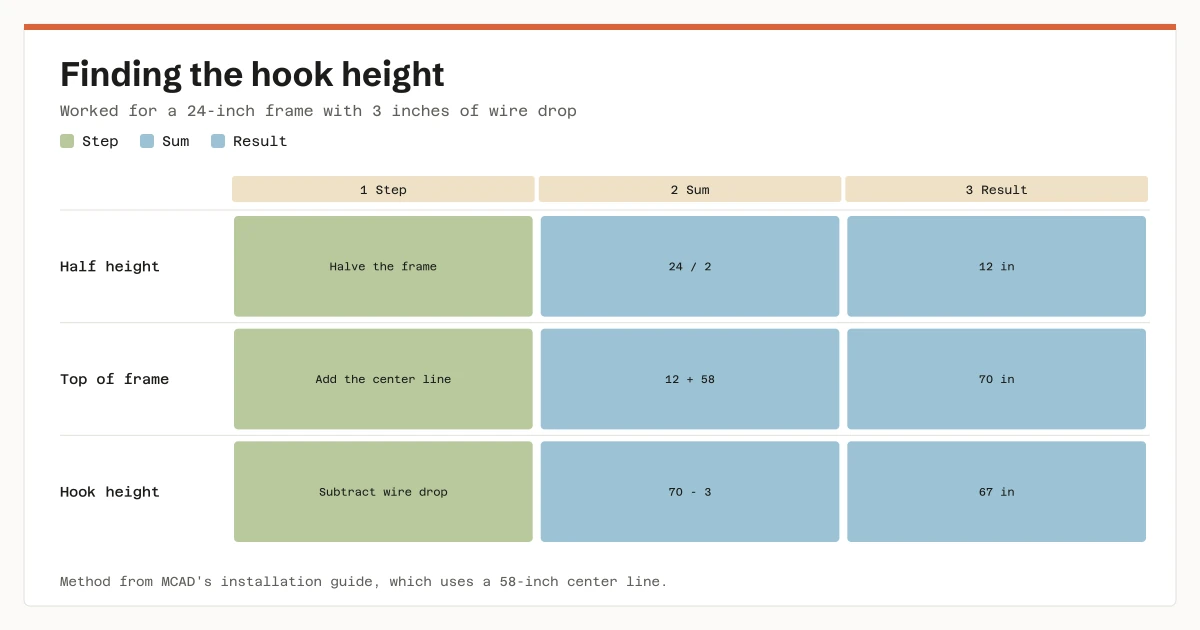
Worked example. A frame is 24 inches tall, with 3 inches of drop. Half of 24 is 12. Add 58 to get 70, the top of the frame. Subtract 3 to get 67 inches, the hook height.
Mark the wall lightly in pencil, at the center of the space you’ve chosen. Measure twice before you drive anything in.
How high should art go over a sofa or console?
Furniture changes the rule, because the art and the piece below should look like one group.
No standards body sets this gap. Most decorators suggest a space of about 6 to 8 inches between the top of the sofa back and the bottom of the frame. That’s a rule of thumb, so hold the art up first and check it before you make a hole.
Some other checks can help:
- Width. Art that’s much narrower than the sofa can look lost. Group two or three pieces if one is too small.
- Head clearance. Leave enough space that a person leaning back won’t bump the frame.
- Above a bed. Don’t use adhesive strips here. Command’s own guidance warns against hanging over beds.
- Dining rooms. Use the seated view, and go a little lower.
How do you lay out a gallery wall?
A gallery wall is a group of frames treated as one big picture. The same center line applies to the whole group.
- Lay it out on the floor. Move frames around until you like the group.
- Measure the whole group, both height and width.
- Set the center of the group at 58 inches. Use the same sum, with the group’s full height.
- Make paper templates. Trace each frame on paper and mark the hook on it.
- Tape the templates to the wall. Stand back and adjust them.
- Hang through the paper, then tear it away.
Even gaps between frames make a group look planned. Pick one gap and keep it the same throughout.
For help placing the group in the room, see room layout basics.
What hardware do you need for the weight?
Weigh the art first. A bathroom scale works: weigh yourself holding it, then without it, and subtract.
Use the rating on the package, and stay under it. Ratings differ by product and wall type. MCAD’s guide says the hooks it uses for wire-backed work hold up to 25 pounds per nail.
For anything heavy, the safest way is a screw into a wall stud. Otherwise, use an anchor rated for your wall, and follow its package. Two hooks spread the load and also keep a frame from tilting.
Heavy art, mirrors and glass need extra care. Put them where a fall won’t hurt anyone, and don’t guess at the wall behind them. A stud finder can help you find framing. If you aren’t sure about the wall, ask a handyman.
What can renters use?
Adhesive strips let you hang art without a nail. Command’s weight limits guide lists a capacity for each product, and the number depends on size and how many strips you use. Read the package for the strip you buy.
Follow the maker’s rules:
- Use smooth surfaces only. Command rules out wallpaper, fabric, textured walls and brick.
- Wait 7 days after painting before you apply them.
- Don’t use them for valuable or irreplaceable items.
- Don’t hang anything over a bed.
- To remove a strip, hold the top lightly and pull straight down, slowly.
Check your lease too. Small nail holes are often allowed, but the rules vary.
Sources
- Minneapolis College of Art and Design, Installing Artwork and Media Guidelines (2023), read on November 8, 2026
- American Alliance of Museums, Accessible Exhibition Design: Walker Art Center Case Study, read on November 8, 2026
- 3M, Command Picture Hanging Strips Technology, read on November 8, 2026
- 3M, Command Product Weight Limits Guide, read on November 8, 2026