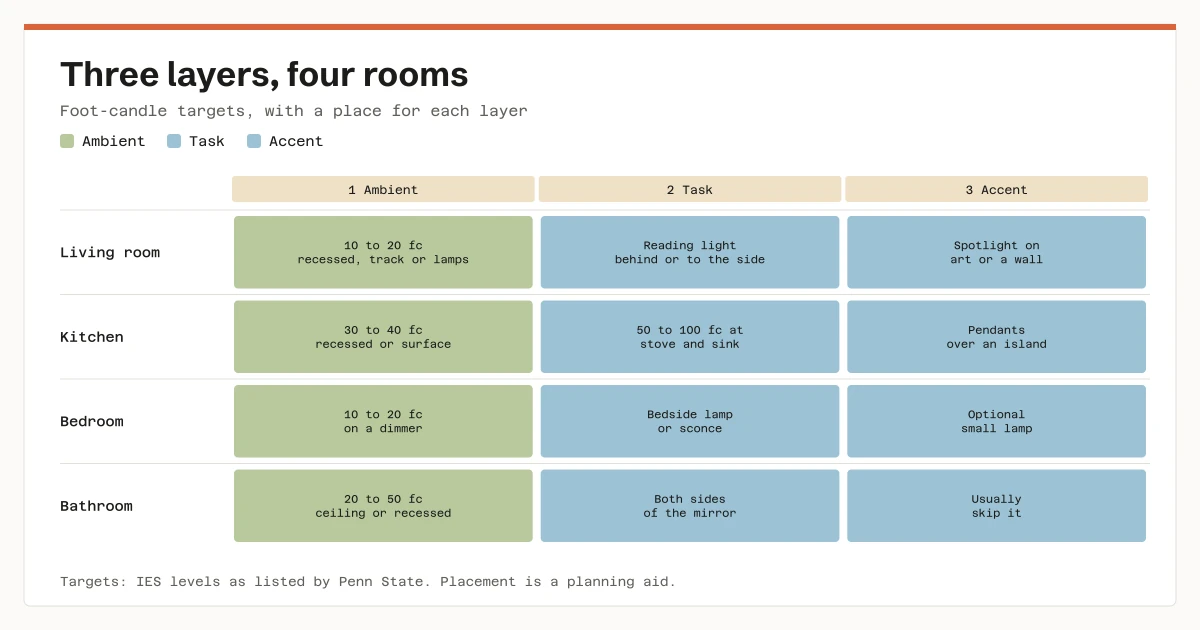
To plan a room’s lighting, list what happens there, then build three layers. Ambient light fills the room. Task light goes where you read, cook or shave. Accent light picks out art or a wall. Kitchens need the most general light, at 30 to 40 foot-candles. Living rooms and bedrooms need 10 to 20, plus a lamp where you read. Put each layer on its own control.
What are the three layers of light?
A Penn State energy course sorts room lighting into three types by job.
- Ambient is general light. It lets you walk through a room safely.
- Task is focused light for a job, such as reading or chopping food.
- Accent highlights an object or area, such as a painting. It can also brighten walls so they blend with bright ceilings and windows.
You don’t need the whole room as bright as your task. The course makes this point directly: lighting every corner to task level wastes energy. So a dim room with a bright reading lamp can be a good plan.
How much you need depends on three things, says a lighting course hosted by ENERGY STAR: the age of the people using the room, the speed and accuracy of the task, and how much light the surfaces reflect. Older eyes may want task light up to 100 foot-candles.
How do you plan a room step by step?
The ENERGY STAR-hosted course uses a three-question plan: what goes on in the room, what lighting solves it, and how to save energy. Here’s how to use it.
- List the activities. Write down everything that happens in the room. Think of cooking, sleeping, playing, reading and walking through.
- Mark where each one happens. Sketch the room and put an X at each chair, counter or desk that needs its own light.
- Set the ambient target. Use the table below. Multiply by floor area to get lumens.
- Add a task light for each X. One lamp or fixture for each spot is a good start.
- Choose one or two accents. A room doesn’t need many. Pick the thing you want people to notice.
- Group the controls. Decide which lights share a switch and which get a dimmer.
Do this before you buy anything. A sketch is free, and moving a ceiling box later isn’t.
How much light does each room need?
Light on a surface is measured in foot-candles. One foot-candle is one lumen spread over one square foot. These are the Illuminating Engineering Society (IES) levels as listed by Penn State. The course notes that light levels are largely a matter of preference, so treat them as a starting point.
| Area | Foot-candles |
|---|---|
| Living room, bedroom (ambient) | 10 to 20 |
| Kitchen, general | 30 to 40 |
| Kitchen, stove and sink | 50 to 100 |
| Bathroom | 20 to 50 |
| Home office or reading area | 20 to 50 |
| Dining room | 30 to 40 |
| Hallway or entry | 5 to 20 |
To turn these into lumens for your own room, use the lumens calculator.
How should you light a living room?
Start with what people do there: talking, reading and watching TV.
- Ambient. Aim for 10 to 20 foot-candles. Recessed lights, track lights or several lamps can do it.
- Task. The ENERGY STAR-hosted course says to place a reading light slightly behind or to the side of the reader.
- Accent. Point a track head or spotlight at art or a textured wall.
Keep lights to the side of a TV, not in front of it, to limit glare. If the room is dark in the day, see how to make a dark room brighter.
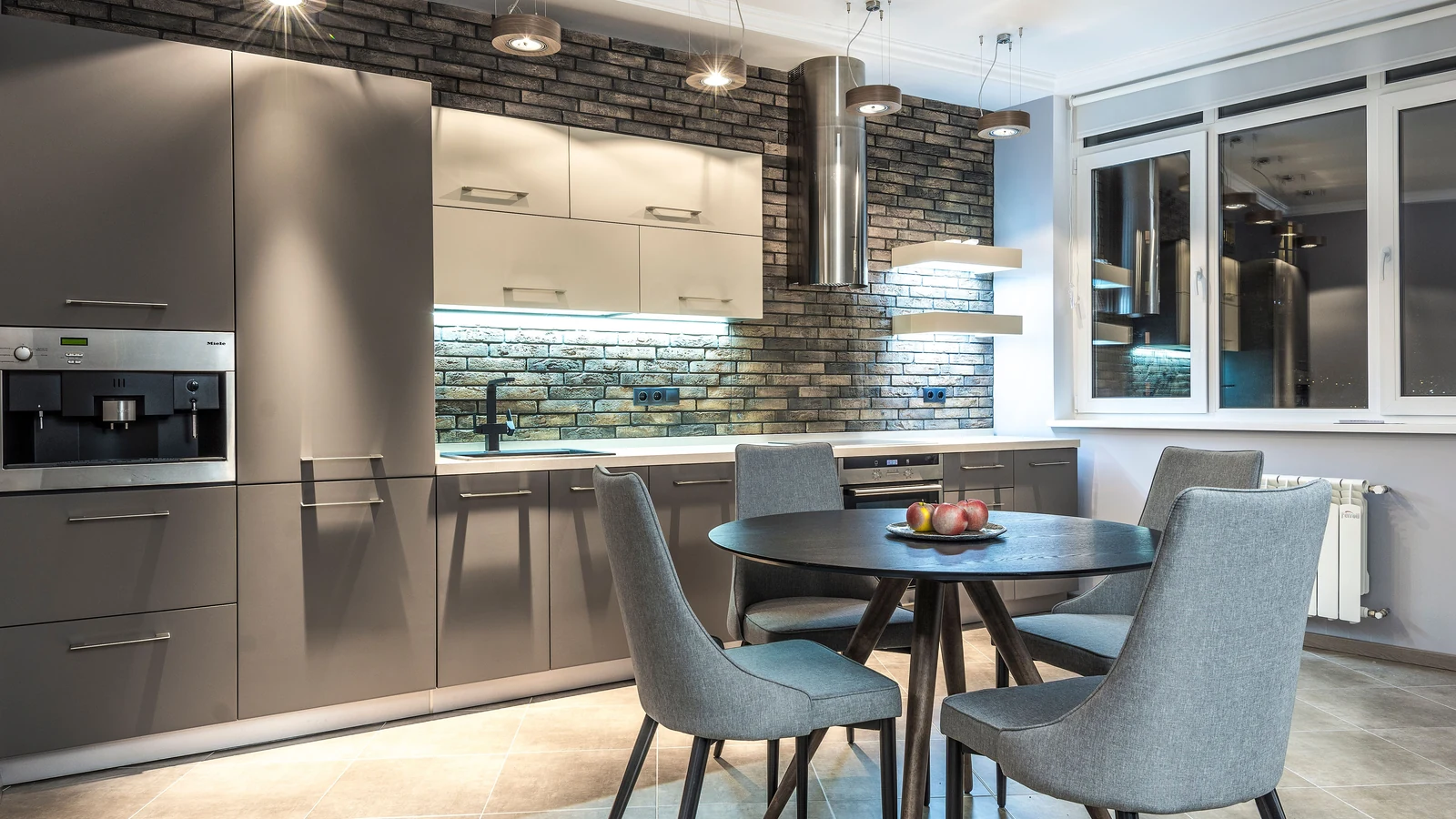
How should you light a kitchen?
Kitchens need the most light, and it needs to land on the counters.
- Ambient. Plan for 30 to 40 foot-candles. For spacing, see recessed lighting spacing.
- Task. The stove and sink call for 50 to 100 foot-candles. Under-cabinet lights put it on the counter, in front of you. A ceiling light behind you casts your shadow on the work. See the under-cabinet lighting guide.
- Accent. Pendants over an island add a focal point and task light together. Get the drop right with how high to hang pendant lights.
How should you light a bedroom?
Bedrooms are for winding down, so softer ambient light works.
- Ambient. Plan for 10 to 20 foot-candles. A dimmer helps most here.
- Task. Use a bedside lamp or wall sconce for each reader.
- Accent. This is optional. A small lamp on a dresser adds a low glow.
Watch one trap. The ENERGY STAR-hosted course warns about ceiling fan strobing when recessed lights sit near a fan. Keep the blades clear of the beam.
How should you light a bathroom?
Bathrooms need 20 to 50 foot-candles. The mirror is the key spot.
- Ambient. Use a ceiling fixture or recessed lights.
- Task. Lights on both sides of the mirror reach your face from each side. See bathroom vanity lighting placement.
- Accent. Most bathrooms can skip this layer.
Check that any fixture near a shower is rated for damp or wet locations. The rating is on the box.
How should you light a dining room and hallway?
Dining rooms have a target of 30 to 40 foot-candles in the IES list. That’s high for a room used for meals, so a dimmer earns its place. The ENERGY STAR-hosted course lists a chandelier or other hanging fixture among the usual choices. Hang it over the table, not the center of the room, if the two don’t line up. The light should serve the place where people sit.
Hallways and entries need only 5 to 20 foot-candles. Their job is safe walking, so even coverage matters more than brightness. Light both ends of a long hall, and make sure stairs are well lit from top to bottom. The same course lists stairs at 10 to 20 foot-candles, and it lists a much lower level of 3 to 5 for transition areas.
Match the light to the room next door as well. Your eyes take a moment to adjust, so a dim hall beside a bright kitchen feels darker than it is.
Which bulb shape fits which fixture?
Layers depend on the right bulb for each fixture. ENERGY STAR’s chart matches shapes to fixtures:
| Fixture | Bulb shapes on the chart |
|---|---|
| Table or floor lamp | Standard |
| Pendant | Standard, globe, MR16, candle |
| Ceiling fixture or fan | Standard, candle |
| Wall sconce | Standard, globe, candle |
| Recessed can | MR16, spot, flood |
| Accent lighting | MR16, spot |
Spot and flood bulbs aim the light. A spot makes a tight pool, which suits art. A flood spreads wider, which suits general light from a can. Always check the fixture’s maximum rating and the bulb’s package for approved uses.
Which bulbs should you choose?
Buy lumens, not watts. ENERGY STAR says lumens show light output, while watts show energy used. To match an old bulb:
| Old incandescent | Minimum lumens |
|---|---|
| 40 watts | 450 |
| 60 watts | 800 |
| 75 watts | 1,100 |
| 100 watts | 1,600 |
Pick a color. Lower Kelvin numbers look warmer. Higher numbers look cooler and bluer. ENERGY STAR calls warm white ideal for most indoor uses, cool white good for kitchens and work spaces, and daylight good for reading. Most old bulbs gave about 2,700 K, the color people expect at home. The Department of Energy warns that a big jump, such as 2,700 K to 4,100 K, is noticeable. So use one color within a room. For more, see what color temperature to buy.
Check color quality. The color rendering index (CRI) shows how true colors look. The ENERGY STAR-hosted course lists 90 for some rooms and above 80 for others.
How do dimmers and controls fit in?
Give each layer its own switch. The University of Pennsylvania’s lighting standard separates task lighting from general room lighting for the same reason, though it was written for campus buildings. At home, it lets you run a soft glow at night and full light for chores.
Not every LED bulb will dim. ENERGY STAR says to look for a bulb marked “Dimmable”. For a three-way socket, look for “3-Way.” DOE adds that you should make sure LEDs work with the dimmer. If yours flicker, see LED lights flickering on a dimmer. Before you change a fixture, read how to replace a light fixture.
Sources
- Penn State, EGEE 102: How Much Lighting is Needed, listing IES residential levels, read on November 8, 2026
- Eaton, LED and Home Energy Savings: The Next Chapter, 2015 course hosted by ENERGY STAR, read on November 8, 2026
- ENERGY STAR, Light Bulb Purchasing Guide and Bulb Purchasing Checklist, read on November 8, 2026
- U.S. Department of Energy, Purchasing Energy-Efficient Light Bulbs, read on November 8, 2026
- University of Pennsylvania, Design Standards: Lighting, read on November 8, 2026