To choose interior paint, pick the sheen first, then the type, then check the label. Flat paint hides wall flaws but is made for ceilings and low-traffic rooms. Glossier paint is easier to clean, but it shows every seam and dent. Most walls take a water-based latex. Kitchens, baths and trim take more sheen. A gallon of one premium wall paint covers 400 to 450 square feet, and two coats are the norm.
What do paint sheens mean, from flat to gloss?
Sheen is how much light a dry coat of paint bounces back, like a mirror. It is read with a gloss meter and given in gloss units.
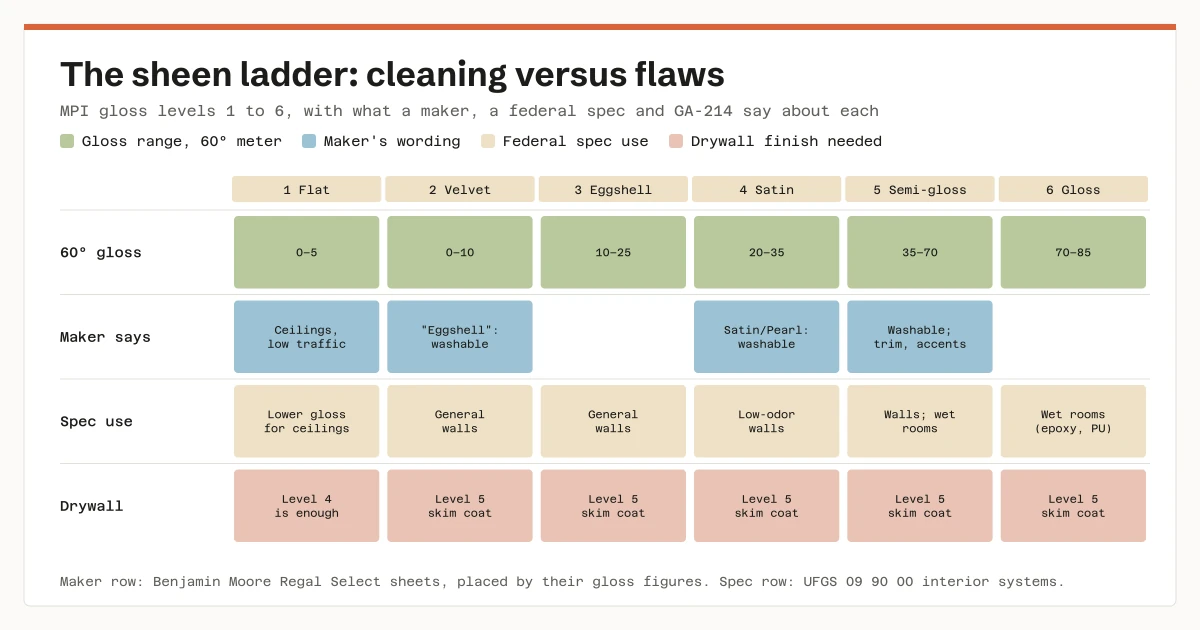
The trade’s scale comes from the Master Painters Institute (MPI). The federal paint spec, UFGS 09 90 00, reprints it. It has seven levels, read on a meter set at 60°:
- G1 flat or matte: 0 to 5 units.
- G2 velvet: 0 to 10.
- G3 eggshell: 10 to 25.
- G4 satin: 20 to 35.
- G5 semi-gloss: 35 to 70.
- G6 gloss: 70 to 85.
- G7 high gloss: 85 and up.
The names on cans don’t always match. The same spec says “flat” has traditionally meant G1 or G2. And Benjamin Moore’s Regal Select eggshell lists the MPI 138 standard, which the spec files under Gloss Level 2, velvet. Its sheen, 15 to 22 at 85°, also sits in the G2 range.
So read the number, not the name. Low sheens are often given at 85°, a low-angle reading. Higher sheens are given at 60°. The two scales differ, so compare like with like.
Federal rules draw one more line. Under 40 CFR 59, a flat coating reads under 5 at 60°, or under 15 at 85°. Anything above that counts as nonflat.
Which sheen is easiest to clean, and which shows flaws?
Gloss is a trade-off. The federal spec uses lower gloss where nobody touches, such as ceilings. It saves higher gloss for places where easy cleaning, or resistance to knocks and wear, is critical.
One maker’s line follows the same pattern, with a twist. Regal Select’s flat is made for ceilings and low-traffic rooms, and it makes no washable claim. The matte, eggshell and satin are all sold as “durable and washable,” for surfaces that take abuse and dirt. So in this line, washable starts at matte, not at satin.
All five sheets add one rule: you can wash the painted wall after two weeks. None of the sheets read here gives scrub-test numbers, so no sheen can be ranked by a figure.
Flaws are the other side of the trade. On a shiny wall, taped seams and screw heads can show through. The trade calls this joint photographing. The Gypsum Association’s GA-214-2022 guide sets five levels of drywall finish. Two matter here:
- Level 4 suits smooth walls with flat paint, light texture or wallpaper. It is not recommended for paint with any sheen, or for dark or deep colors.
- Level 5 adds a thin skim coat over the whole wall. It is the level for paint with sheen or gloss, for deep colors, and for walls under critical lighting.
Critical lighting means light that strikes a wall at a low, slanting angle. Large windows, skylights and surface-mounted fixtures all do it. Light that rakes across a wall shows more than light that hits it head-on.
If a wall has dents, patches or seams that show, fix them before you go glossier. See how to patch drywall. Otherwise, drop a step down the ladder.
Latex, alkyd or hybrid: what’s the difference?
Most wall paint today is water-based latex, usually acrylic. Alkyd is the old oil-based kind. Hybrids sit in between.
Latex. Regal Select is 100% acrylic. It cleans up with water and can take a second coat in 1 to 2 hours. The semi-gloss needs 3 hours. Water-based paints are lower in VOCs than solvent-based paints, and they clean up with water. That is why latex is the default.
Alkyd. Alkyd dries slower and harder, and it yellows. Benjamin Moore’s Super Spec Alkyd Semi-Gloss needs 16 hours before a second coat. It cleans up with mineral spirits, and it takes 3-4 weeks to reach its final semi-gloss finish. All alkyd enamels yellow to some degree, the sheet warns, and faster in dark or poorly aired rooms.
PPG’s Glyptex alkyd satin waits 24 hours between coats. Its yellowing shows most in whites and light colors. Where yellowing is a concern, PPG points you to its latex paints.
Both alkyd sheets carry the same fire warning. Rags soaked with the paint “may spontaneously catch fire” if thrown out the wrong way. Right after use, put them in a sealed metal container filled with water.
Hybrids. These are water-based paints with alkyd or urethane in the resin. Benjamin Moore’s ADVANCE is a waterborne alkyd that cleans up with soap and water. It still waits 16 hours between coats. It yellows less than standard alkyds, though some yellowing can still occur. Sherwin-Williams’ Emerald Urethane Trim Enamel aims for the look, feel and toughness of an oil-based enamel. It takes a second coat after 4 hours.
Painting over old alkyd takes prep. Sand glossy alkyd before you apply ADVANCE. Regal Select asks for glossy areas to be dulled.
When do you need a primer?
Not always. Regal Select is self-priming on most well-prepared surfaces, drywall included. It still calls for two coats on bare surfaces. Old paint in good shape can take 1 or 2 coats.
Federal specs prime anyway. Every UFGS wallboard system starts with a latex primer, then two topcoats. The Drywall Finishing Council’s Level 4 and 5 paint finishes also begin with one coat of drywall primer. That primer is made to even out how the paper and the joint mud soak up paint.
The maker’s own sheet names the cases that need a special primer:
- Stains. Ask for a special-purpose primer if the wall is water stained, smoke damaged, grease stained or very slick.
- Bleeding woods, such as redwood and cedar, take Fresh Start primers.
- Deep colors. Some custom colors need a Deep Base Primer, tinted to a set formula.
- Bare patches in old paint: prime them with the primer the sheet lists for that surface.
For stains, a shellac primer such as Zinsser B-I-N is sold as a stain killer. It is alcohol-based, with a flash point of 54°F, so keep flames away. Over slick paint, even a bonding primer like Insl-X Stix says glossy painted surfaces should be properly deglossed.
Primer is one step of wall prep. Cleaning, patching and sanding come first; see how to prep walls for painting.
How much does a gallon of interior paint cover?
Coverage is printed on the data sheet as a spread rate. All five Regal Select sheets give 400 to 450 square feet per gallon. That assumes a wet coat 3.6 to 4.0 mils thick.
The sheet hedges at once: it depends on surface texture and porosity. Rough, bare or patchy walls drink more paint. The maker also says to estimate the right amount for the job. That keeps the color the same from can to can, and leaves less to throw away.
Two coats is the usual plan. Benjamin Moore says one coat is sometimes enough, but it recommends two for full color. An even color and sheen may not come from one coat of primer or topcoat alone, the Drywall Finishing Council adds.
So budget for two coats over the full wall area, plus primer where needed. To work out gallons for a room, see how much paint a room needs.
What do VOC labels on paint mean?
VOCs are volatile organic compounds, the solvents that evaporate as paint dries. Paints, varnishes and wax all contain them. The figure on a can or data sheet is in grams per liter (g/L).
Federal law sets a ceiling. Under EPA’s rule at 40 CFR 59, interior flat paint may hold up to 250 g/L. Interior nonflat paint may hold 380 g/L, and primers 350 g/L. These limits leave out any colorant added to tint bases.
Real products sit well apart, as their sheets show. Compare each with EPA’s limits:
- Regal Select flat to satin: under 50 g/L. The semi-gloss: under 100 g/L.
- ADVANCE: 43 g/L.
- Super Spec Alkyd: 372 g/L, for the pastel base.
- Glyptex alkyd satin: under 380 g/L.
- B-I-N shellac primer: 550 g/L at most.
Labels change between versions, so read the current sheet. A 2018 Regal Select eggshell sheet said “Zero VOC post tint.” The 2025 sheet says under 50 g/L. Also check which tint base a figure is for.
Low VOC does not mean no fumes. EPA says to increase ventilation when you use products that give off VOCs, and to meet or exceed any label precautions. It also says to buy only as much paint as you will use right away. The Regal Select sheets ask for fresh air while the paint goes on and while it dries.
Old paint under the new coat matters more than the new can. EPA says the federal government banned lead-based paint for homes in 1978. About three-quarters of U.S. homes built before then still contain some lead-based paint. Every paint sheet in this guide carries a lead warning. Most say that sanding or scraping old paint may “release lead dust”.
In a pre-1978 home, EPA recommends a certified lead inspector or risk assessor test the surfaces first, or assuming lead is present and using lead-safe practices. If you must sand, EPA says to wet the area first and sand as little as you can. For paid work, hire a lead-safe certified firm, licensed where your state requires it. More in lead paint in older homes.
Which paint should you use in each room?
Put the pieces together and each room points to a sheen and a wall finish. These picks restate the sources above; none is a product endorsement.
| Room or surface | Sheen the sources point to | Drywall finish (GA-214) | Why |
|---|---|---|---|
| Ceilings | Flat (G1) | Level 4 | The federal spec uses low gloss on ceilings. Regal Select’s flat is made for them. |
| Living rooms, bedrooms | Flat to eggshell (G1 to G3) | Level 4 for flat; Level 5 for eggshell | Federal wall systems run G2, G3 and G5. |
| Halls, kids’ rooms, stairs | Matte to satin, sold as washable | Level 5 once it has sheen | The maker sells these for surfaces that take abuse and dirt. |
| Kitchens, baths, laundry | Semi-gloss or gloss (G5 to G6) | Level 5 | The federal spec uses G5 and G6 in high-humidity rooms and food-prep areas. |
| Trim, doors, cabinets | Semi-gloss enamel, latex or hybrid | Not drywall | Regal Select’s semi-gloss is made for trim and accents. Hybrids yellow less than alkyds. |
| Dark accent walls | Any sheen, on a smooth wall | Level 5 | GA-214 puts deep colors at Level 5. Some colors need a tinted primer. |
A few notes on the table:
- Kitchens and baths. The federal wet-room systems include alkyd, light industrial, epoxy and polyurethane coatings. Those are commercial coatings. The part a home can copy is the sheen level. Regal Select’s eggshell is also sold as mildew-resistant.
- Trim. Trim takes knocks, and gloss is easier to wipe. For the job itself, see how to paint baseboards. On cabinets the waits run longer; see the cabinet painting guide.
- Accent walls. Deep colors show seams the way gloss does. Pick the shade with how to choose paint colors, then see accent wall ideas.
- Wallpaper instead. GA-214’s Level 4 also covers wallpaper, but unbacked vinyl needs a smoother wall. The Drywall Finishing Council calls for a wallpaper primer first. See how to hang wallpaper. If old paper is coming off before you paint, start with how to remove wallpaper.
Sources
- U.S. Army Corps of Engineers, NAVFAC and AFCEC, UFGS-09 90 00 Paints and Coatings (August 2026), read on November 7, 2026
- EPA, 40 CFR Part 59 Subpart D, VOC emission standards for architectural coatings, read on November 7, 2026
- Gypsum Association, GA-214-2022 Recommended Levels of Finish for Gypsum Panel Products, Quick Reference Guide, read on November 7, 2026
- Drywall Finishing Council, Recommended Levels of Paint Finish Over Gypsum Board, read on November 7, 2026
- Benjamin Moore, Regal Select technical data sheets: Flat N547, Matte N548, Eggshell N549, Satin/Pearl N550, Semi-Gloss N551 and the 2018 Eggshell 549 sheet, each read on November 7, 2026
- Benjamin Moore, Super Spec Alkyd Semi-Gloss Enamel C271 technical data sheet, read on November 7, 2026
- Benjamin Moore, ADVANCE 793 technical data sheet, read on November 6, 2026, and Insl-X Stix technical data sheet, read on November 6, 2026
- PPG, Glyptex Interior Alkyd Enamel Satin 39-10 data bulletin, read on November 7, 2026
- Sherwin-Williams, Emerald Urethane Trim Enamel product data sheet, read on November 6, 2026
- Rust-Oleum, Zinsser B-I-N Shellac-Base Primer technical data sheet, read on November 6, 2026
- EPA, Volatile Organic Compounds’ Impact on Indoor Air Quality, read on November 6, 2026; Protect Your Family from Sources of Lead, read on November 7, 2026; and Lead-Safe Renovations for DIYers, read on November 6, 2026