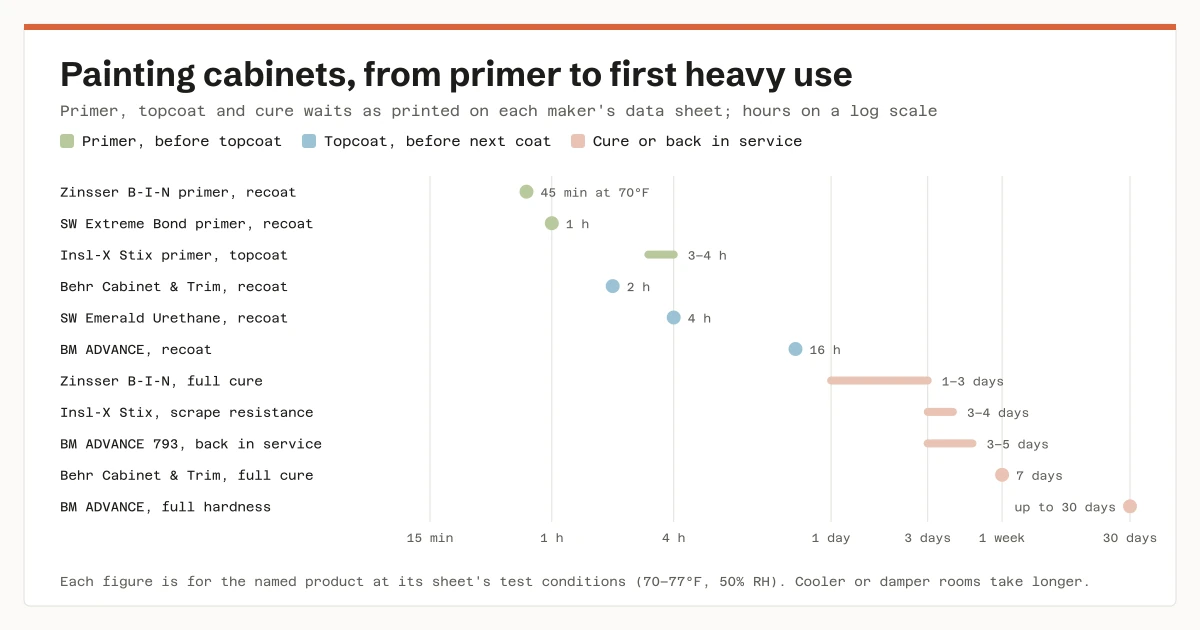
To paint kitchen cabinets so the finish lasts, degrease the boxes and doors, sand every surface dull, and prime. Then apply two coats of a cabinet enamel. Leave them alone until the sheet’s cure time has passed. The schedule comes from the cans. A primer can be ready for topcoat in under an hour or in four. A topcoat recoat takes 2 to 16 hours, and the finish needs days to weeks before it takes hard knocks.
Which paint is best for kitchen cabinets?
Cabinet paints fall into three families: acrylic enamel, waterborne alkyd hybrids and lacquer.
Acrylic enamel. Behr’s Cabinet, Door & Trim enamel lists its resin as acrylic. Behr says it “dries to a hard, durable finish”, with block resistance that allows a “quick return to service”.
Waterborne alkyd hybrids. Benjamin Moore calls ADVANCE “a premium quality, waterborne alkyd enamel”, with the flow and leveling of conventional alkyd paint. Sherwin-Williams describes Emerald Urethane Trim Enamel as a “urethane modified alkyd”. It gives “the look, feel and durability of an oil based enamel with the convenience of a waterbased formula”.
The trade-off is time. ADVANCE waits 16 hours between coats. Its sheet also warns that slight yellowing can occur, faster “in dark or poorly ventilated areas”.
Lacquer is a finishing-shop job, not a weekend one. PPG’s pigmented white lacquer for cabinets is “Recommended for spray only”. It dries to recoat in 30 minutes and has a flash point of 40°F. Its VOC content is around 600 grams per litre, against under 50 for the three enamels above.
The PPG sheet calls for explosion-proof equipment in confined areas. It also warns that lacquer’s solvents can lift or wrinkle old alkyd and varnish finishes, which it says to remove completely first.
How do you clean cabinets before painting?
Take off the doors, drawer fronts and hardware, numbering each piece and its opening. Then clean the doors and the boxes. Kitchen cabinets carry a film of cooking grease, and every sheet asks for it to come off first. Each maker names its own cleaning step:
- Behr: scrub dirt and grease “with a detergent and water solution, followed by a thorough rinsing with clean water”.
- Zinsser B-I-N: if unsure, wash with “household ammonia and water solution”. The B-I-N sheet says “do not use TSP as a cleaner”.
- Insl-X Stix: the Stix sheet says “Grease residue should be removed with a grease and oil emulsifier”.
- Sherwin-Williams: wash with a suitable cleaner, rinse well and let the surface dry.
Rinse off whatever cleaner you use, then let everything dry.
Do you have to sand cabinets before painting?
Yes. Sand everything dull, even with a bonding primer. Every topcoat sheet asks for a dull surface, so scuff-sand regardless.
Benjamin Moore’s cabinet instruction is the most specific: “All surfaces to be roughened by sanding (220 grit or coarser) before priming”. It adds light sanding between coats for a smoother finish, and “all dust must be cleaned”. Behr’s label suggests sanding the primer before topcoating and, optionally, “320-400 grit” between coats.
Bonding primers hedge. Sherwin-Williams says Extreme Bond may not need sanding on “most clean, paintable surfaces”. Yet the same sheet says “Sand glossy surfaces dull”. The Stix sheet says glossy painted surfaces “should be properly deglossed”.
Which primer should you use on cabinets?
Pick the primer by its job and its wait:
- Zinsser B-I-N (shellac): blocks stains and seals bare wood. Touch dry in 20 minutes, recoat in 45 at 70°F, full adhesion after 1 to 3 days. Apply only below 70 percent humidity. It is alcohol-based, with a 54°F flash point.
- Sherwin-Williams Extreme Bond (urethane-modified acrylic): lists kitchen cabinets among its surfaces. Recoat in 1 hour as a primer, and it “Must be topcoated within 14 days”.
- Insl-X Stix (acrylic urethane): topcoat within 3 to 4 hours, but allow about 3 to 4 days “to achieve maximum resistance to scrape off”.
The topcoat sheets name their own primers too: ADVANCE Primer (790) for ADVANCE on wood and MDF, and Behr’s No. 75 Kitchen, Bath & Trim primer for its enamel.
In homes built before 1978, older cabinets may carry lead-based paint. Every sheet quoted here prints the same warning about lead dust from sanding. EPA recommends having a certified lead inspector or risk assessor test the surfaces first. If that cannot be settled, assume lead-based paint is present and use EPA’s lead-safe practices:
- Seal off the work area.
- Cover floors with plastic.
- Wet-sand.
- Clean up with a HEPA vacuum.
The federal RRP rule requires certification for anyone paid to do this work. It generally does not apply to owners working in their own home unless they rent it out, run a child care center there or flip houses. EPA recommends that homeowners hire a lead-safe certified contractor. Also check that the firm is licensed wherever your state or city requires it.
Should you brush, roll or spray cabinets?
All three methods work with the enamels here, and the sheets give the settings:
| Product | Brush and roller | Airless spray tip | Thinning |
|---|---|---|---|
| Behr Cabinet, Door & Trim 7120 | Nylon brush; 1/4-inch nap | .013–.015 in., 1,400–2,400 psi | “DO NOT THIN” |
| SW Emerald Urethane (gloss) | Nylon-polyester brush; 1/4 to 1/2-inch nap | .013–.017 in., 2,000 psi | “No reduction needed” |
| BM ADVANCE 793 | Nylon/polyester brush; microfiber roller | .011–.015 in., 1,500–2,500 psi | Small amount of clean water only if needed |
| Zinsser B-I-N primer | Natural or synthetic brush; roller | .011–.013 in., 800–1,200 psi | “DO NOT THIN” |
| Insl-X Stix primer | Nylon brush; 1/4 to 1/2-inch synthetic nap | .013–.017 in., 2,200–2,500 psi | “Do not thin” |
Benjamin Moore adds “Never add other paints or solvents” and says to work “from unpainted area into wet area”.
A sprayer also needs masking and a well-aired space. PPG’s sheet warns that airless equipment can inject coating into the skin and “may cause serious injury”.
How to ventilate and when to paint
Ventilate while priming and painting. EPA’s advice on volatile organic compounds is to “Increase ventilation when using products that emit VOCs” and to “Meet or exceed any label precautions”. Behr and Sherwin-Williams both ask for open windows and doors during application and drying.
In a pre-1978 kitchen, the two stages differ. EPA’s lead-safe set-up closes the windows while sanding. The room is aired for painting once that dust is cleaned up.
Check temperature and humidity. ADVANCE’s sheet sets a surface temperature of 50 to 90°F. Behr’s asks for air, surface and paint between 50 and 90°F. Benjamin Moore says not to apply ADVANCE above 85 percent humidity, and suggests a fan or air conditioning to dry the room.
How long does cabinet paint take to cure?
Dry to touch is not cured. At 77°F and 50 percent humidity, the sheets give these figures:
- Behr Cabinet, Door & Trim: recoat in 2 hours, full cure in 7 days. The TDS says to “Allow one week before washing”. The label says the cured film may be cleaned with mild detergent “After 2 weeks”. Wipe with water and a soft sponge until the two weeks are up.
- Benjamin Moore ADVANCE: recoat in 16 hours. Keep heavy abrasion off for “at least 3-5 days” for semi-gloss 793, or 5 to 7 days for satin 792. Reaching “optimum hardness and final sheen” can take up to 30 days.
- Sherwin-Williams Emerald Urethane: recoat in 4 hours. Neither PDS reviewed gives a full-cure time.
Hold off on scrubbing until the longest figure on your can has passed. For where cabinet paint fits in a wider kitchen update, see kitchen refresh planning.
Sources
- Behr, Cabinet, Door & Trim Enamel 7120 technical data sheet, read on November 6, 2026, and 7120 label, read on November 4, 2026
- Benjamin Moore, ADVANCE 793 technical data sheet, read on November 6, 2026, and Insl-X Stix technical data sheet, read on November 6, 2026
- Sherwin-Williams, Emerald Urethane Trim Enamel product data sheet, read on November 6, 2026, and Extreme Bond Primer product data sheet, read on November 6, 2026
- Rust-Oleum, Zinsser B-I-N Shellac-Base Primer technical data sheet, read on November 6, 2026
- PPG, SPEEDLINE lacquer technical data sheet, read on November 6, 2026
- EPA, Lead-Safe Renovations for DIYers, read on November 6, 2026; Lead Renovation, Repair and Painting Program, read on November 6, 2026; and Volatile Organic Compounds’ Impact on Indoor Air Quality, read on November 6, 2026