What size dehumidifier you need depends on floor area and dampness. ENERGY STAR recommends 20 to 30 pints a day for a slightly damp space under 2,000 square feet, 25 to 40 for a very damp one and 30 to 50 for a wet one. Larger spaces need more.
Check the label’s age, too. Units made since mid-2019 are tested at 65°F instead of 80°F and report fewer pints. ENERGY STAR puts an old 50-pint model at roughly a new 30-pint one.
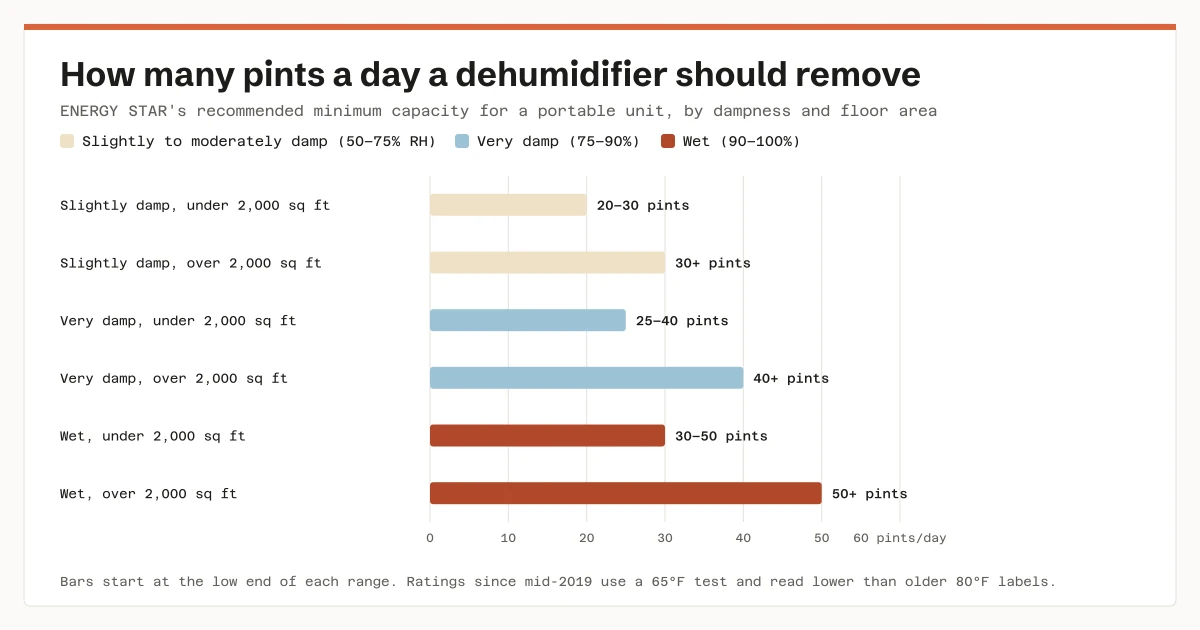
How is dehumidifier capacity rated?
Capacity is the water a unit removes in a day under fixed test conditions. The federal test method, Appendix X1 to 10 CFR Part 430, defines it as “pints collected per 24 hours of operation under the specified ambient conditions.” Those conditions are:
- Portable units: 65°F and 60 percent relative humidity.
- Whole-home units: 73°F and 60 percent.
Why do newer dehumidifiers show fewer pints?
The test used to be warmer. The Department of Energy (DOE) notes that the industry standard dropped its test temperature “from 80 [deg]F … to 65 [deg]F”, keeping the same humidity. DOE settled on 65°F because it expects the average ground temperature during the dehumidifying season to be “close to 65 [deg]F”.
Cooler air holds less water, so the same machine now scores lower. The new federal standards cover units made from June 13, 2019. ENERGY STAR says the lower labels appeared “in early 2020”. Its rough conversion, which it says varies by model:
| Old rating (through 2019) | New rating, approx. (2020) |
|---|---|
| 30 pints/day | 20 |
| 50 | 30 |
| 70 | 40–45 |
| 90 | 55 |
A pint figure in an older review, manual or listing can’t be compared directly with a current label.
What size dehumidifier for your room and dampness?
ENERGY STAR sizes a unit by two inputs: the size of the space and how damp it is without a dehumidifier. Its chart sorts dampness into three conditions. The quick sizing table at the end gives the capacity for each.
- Slightly to moderately damp: feels damp and smells musty at times; 50 to 75 percent relative humidity.
- Very damp: always feels and smells damp, with damp spots on walls and floors; 75 to 90 percent.
- Wet: walls or floors sweat, water seeps in, or laundry dries there; 90 to 100 percent.
Treat the chart’s figures as minimums: “it’s better to oversize than undersize”. A few more points:
- Replacing a unit? The water emptied each day is a guide.
- Only two size bands. The chart splits at 2,000 square feet; no agency source found gives a finer rule.
- Unlabeled rating basis. The chart doesn’t say which test its pints use, so translate an older unit’s rating first.
When a wet space needs more than a dehumidifier
Seepage and sweating walls point to a water source, and a bigger machine won’t fix it. EPA warns that if the water problem isn’t fixed, “most likely, the mold problem will come back”. Standing water from a leak or seepage through a foundation wall is work for a licensed plumber or contractor. ENERGY STAR suggests extending downspouts away from the foundation. The mold prevention checklist goes room by room, and should you test your house for mold covers a musty smell with no visible source.
What humidity should a dehumidifier hold?
CDC advises indoor humidity no higher than 50 percent. Every ENERGY STAR unit has a built-in humidistat that cycles it to hold a set level. A separate hygrometer hung near the unit checks it. The indoor humidity guide covers targets by season.
Basements vs living spaces
Cold basements. ENERGY STAR says frost can form on the coils below 65°F. In a space that is often that cold, it suggests a unit specified for lower temperatures. Makers’ current ratings go lower:
- Frigidaire: 41°F to 89°F
- GE: 41°F to 90°F
- LG: 41°F to 90°F
An older LG manual said 65°F, so check the exact model. LG also suggests a table or shelf, wheels blocked, to keep the coils out of the colder air near the floor.
Placement. Close the doors and windows to the space. Frigidaire and GE say a basement unit does little for a closed storage room beside it unless air circulates. Frigidaire and LG ask for 12 inches of clearance on all sides, GE for 18. GE adds: keep it away from the clothes dryer.
Living spaces in winter. A dehumidifier won’t stop winter window condensation. North Dakota State University Extension says dehumidifiers bring humidity down “to only about 50 percent”.
Whole-home units connect to the ducts. ENERGY STAR says they suit well-sealed homes with central air that read above 55 percent throughout. A professional should size and install them.
How to drain a dehumidifier
- The bucket. Most portables shut off and signal when it is full, ENERGY STAR notes.
- A gravity hose. A hose on the drain fitting sends water to a floor drain or sump. Frigidaire recommends a 1/2-inch or larger hose with no kinks or rises, and capping the fitting when no hose is attached. GE says the hose “must run down” to the drain, and must come off when the bucket is in use. ENERGY STAR advises a short hose, with no tripping hazard.
- An internal pump. Some models pump water upward. GE’s manual gives a maximum lift of 16 feet, requires the included hose, and says not to run the unit at 41°F or below.
- Whole-home drains. These go to a floor drain or a condensate pump, routed by an HVAC professional during installation, per ENERGY STAR.
Plug the unit straight into a grounded outlet, without an extension cord, as Frigidaire directs. Keep hoses clear of cords and outlets, as ENERGY STAR advises. Frigidaire calls for cleaning the filter every two weeks. EPA asks that dehumidifiers not “become sources of biological pollutants” themselves.
How efficient is an ENERGY STAR dehumidifier?
Efficiency is the Integrated Energy Factor (IEF): liters removed per kilowatt-hour, counting power drawn while cycled off. Higher is better. ENERGY STAR’s Version 6.0 criteria apply to units made from October 1, 2025. They set floors above the federal minimum:
| Portable capacity | Federal minimum IEF | ENERGY STAR IEF | kWh per 100 L, federal / ENERGY STAR |
|---|---|---|---|
| 25 pints/day or less | 1.30 | 1.70 | 76.9 / 58.8 |
| 25.01 to 50 | 1.60 | 2.01 | 62.5 / 49.8 |
| Over 50 | 2.80 | 3.30 | 35.7 / 30.3 |
The last column is 100 divided by the IEF; 100 liters is about 211 pints. In the middle class, a certified unit uses about 20 percent less energy for the same water. That matches ENERGY STAR’s “20% less energy”. The gap is 23.5 percent for small units and 15 percent for large ones.
Quick sizing table
Pints per day for a portable unit. ENERGY STAR’s chart does not label its rating basis; the last two rows translate an old label.
| Space | Rule used | Capacity |
|---|---|---|
| Slightly to moderately damp, under 2,000 sq ft | ENERGY STAR chart | 20–30 |
| Slightly to moderately damp, over 2,000 sq ft | ENERGY STAR chart | 30+ |
| Very damp, under 2,000 sq ft | ENERGY STAR chart | 25–40 |
| Very damp, over 2,000 sq ft | ENERGY STAR chart | 40+ |
| Wet, under 2,000 sq ft | ENERGY STAR chart | 30–50 |
| Wet, over 2,000 sq ft | ENERGY STAR chart | 50+ |
| Replacing an old 50-pint unit | ENERGY STAR old-to-new conversion | about 30 |
| Replacing an old 70-pint unit | ENERGY STAR old-to-new conversion | about 40–45 |
Sources: ENERGY STAR, DOE and the eCFR, listed below.
Sources
Each source is listed with the date it was read.
- CDC, Mold, read November 6, 2026
- eCFR, Appendix X1 to Subpart B of Part 430, read November 6, 2026; 10 CFR 430.32, read November 6, 2026
- ENERGY STAR, Dehumidifiers, read November 6, 2026; Dehumidifier Testing and Capacity, read November 6, 2026; Dehumidifiers Version 6.0 Final Specification, read November 6, 2026
- EPA, What are the main ways to control moisture in your home?, read November 6, 2026
- Frigidaire, Dehumidifier use and care guide, read November 6, 2026
- GE Appliances, Dehumidifier owner’s manual, read November 6, 2026
- LG, Dehumidifier general usage, read November 6, 2026; LD40E, LD50EL, LD65EL and LD50EBL manual, read November 6, 2026
- North Dakota State University Extension, Eliminate Condensation on Windows, read November 4, 2026
- U.S. Department of Energy, Federal Register, Dehumidifier test procedure rule (2023), read November 6, 2026; dehumidifier rule (2015), read November 6, 2026