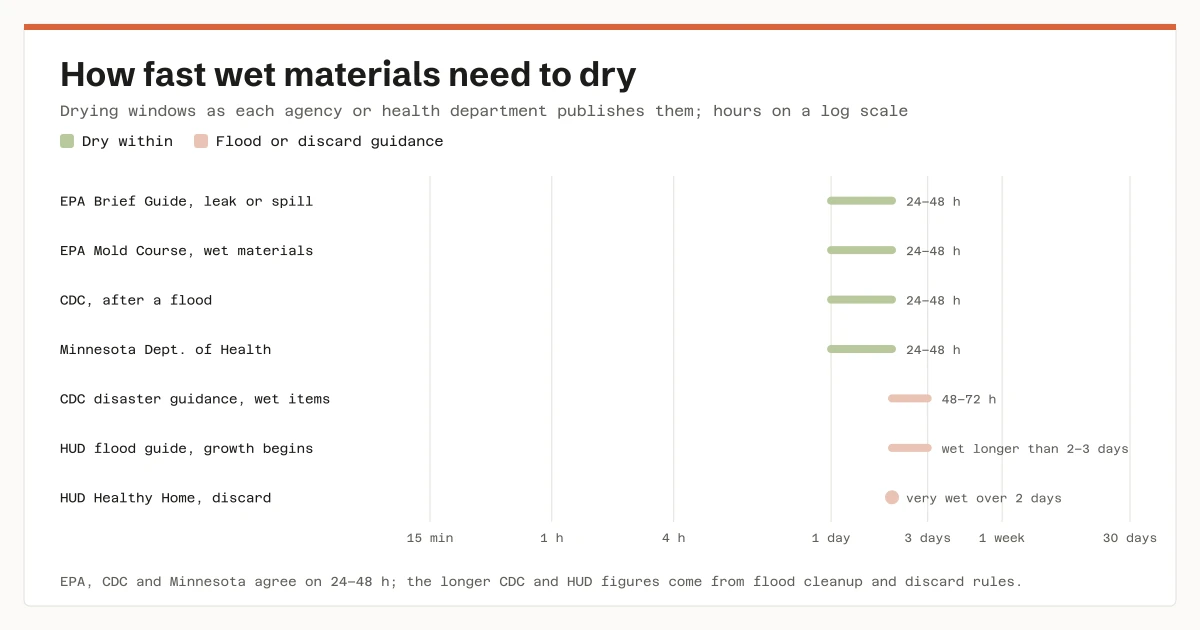
To prevent mold in a house, find each source of water and shut it off, because mold only grows where something stays damp. Vent bathrooms, kitchens and the dryer outdoors. Fix leaks, keep rain away from the foundation and keep the air conditioner’s drain pan flowing. EPA’s advice is to dry anything that gets wet within 24 to 48 hours.
Why does mold grow in a house?
Spores are already in every house, in the air and in dust, and no cleaning removes them all. What they lack is water. EPA’s brief guide to mold puts it plainly: “none of them will grow without water or moisture,” and “The key to mold control is moisture control.” Clean up growth without fixing the water behind it, and the problem “will come back.”
So prevention is an inspection job, room by room. The National Institute of Environmental Health Sciences names the usual causes: “Flooding, leaky pipes, humid conditions, and poor ventilation.”
Keep a hygrometer in the living space too. EPA’s ceiling is 60 percent relative humidity, and CDC’s is 50. The indoor humidity guide covers targets by season.
How to prevent mold in bathrooms and kitchens
These rooms make moisture every day, so remove it where it starts, as EPA advises:
- Run the fan for every shower and while cooking. EPA adds running the dishwasher and washing dishes.
- Make sure the fan reaches outdoors. EPA says “to the outside (not into the attic),” and CDC asks for kitchen and bathroom fans “that vent to outside your home.”
- Squeegee the shower walls after use and hang towels to dry, as HUD’s healthy-home booklet suggests.
- Open the cabinet under each sink and feel the pipes and the cabinet floor. EPA names leaks around tubs and sinks as a common problem.
- Check the drip pan under the refrigerator for standing water, another HUD item.
If spots in the shower keep returning, more ventilation and more frequent cleaning “will usually prevent mold from recurring,” according to EPA’s mold cleanup guide. Never seal over growth. Re-caulking a bathtub covers stripping and resealing the joint. The bathroom fan sizing guide covers a fan too weak for the steam.
Does the dryer vent cause mold?
It can if it vents indoors. Vent the clothes dryer outside, as EPA, CDC and HUD all advise. EPA’s mold course flags dryers vented into a garage as a moisture problem.
The Consumer Product Safety Commission adds two checks from its dryer fire guidance (Publication 5022):
- With the dryer running, make sure air is coming out of the outside vent.
- Replace plastic or foil accordion duct with rigid or semi-rigid metal duct.
How to keep a basement or crawl space from getting moldy
Below-grade rooms take on water from the soil and from rain that reaches the foundation. The fixes, mostly from EPA’s moisture-control page and HUD’s booklet:
- Keep gutters clean and downspouts pointed away from the house. EPA links basement water to missing gutters and ground that drains toward the house.
- Check the grade. HUD’s booklet says the soil six feet out should sit lower than the soil against the wall.
- Cover leaking window wells and clear floor drains that hold water, two more HUD items.
- Skip wall-to-wall carpet on concrete. EPA suggests washable area rugs, and CDC advises against carpet in damp basements.
- Run a dehumidifier where the air stays damp, and keep it clean so it does not become a source itself, as EPA cautions. The dehumidifier sizing guide covers capacity.
Crawl spaces need a look even if nobody goes down there. EPA’s mold course calls damp ones “common sites of hidden mold growth, particularly if the crawl space has a bare earth floor.” The soil wicks moisture up, it evaporates into the crawl-space air, and it can pass into the rooms above through cracks.
EPA recommends a plastic cover over exposed dirt. Beyond that, design depends on climate, so have a licensed contractor assess a crawl space that stays wet.
Keep the air conditioner’s drain pan flowing
The cooling coil pulls water from the air into a drain pan. Keep pans clean “and the drain lines unobstructed and flowing properly,” says EPA’s air-duct guide. It treats substantial standing water in the pan as “a problem requiring immediate attention.”
At each service visit, ask for two things:
- the coils and pan cleaned;
- ducts in attics and crawl spaces sealed and insulated against condensation.
How to stop condensation on windows and exterior walls
In cold weather, indoor moisture condenses on the coldest surfaces. Dry the surface quickly and cut the source, since condensation “can be a sign of high humidity,” as EPA’s brief guide notes. The trouble spots, from EPA and HUD:
- Cold corners behind furniture, where EPA’s mold course says growth is often found. Move furniture away from outside walls. Open closet doors, since closets run colder than the rooms around them.
- Window glass. Storm windows and caulking around the frame keep the inner glass warmer. EPA says an interior storm window works better than an exterior one.
- Leaks from outside. HUD lists repairing leaking roofs, walls, doors and windows among its first action steps.
- Too much indoor moisture. EPA names long showers, boiling pots, houseplants, clothes drying indoors and an over-set humidifier.
After heavy rain, check the attic floor for drips, as HUD suggests. Minnesota’s health department adds ice dams to the list of roof leaks and points to sealing air leaks between the house and the attic. A licensed roofer can trace a leak that keeps coming back.
When does mold cleanup need a professional?
Above about 10 square feet, roughly 3 feet by 3 feet. Below that, a homeowner can usually handle cleanup. Above it, or after heavy water damage, EPA’s remediation guidance applies. HUD’s booklet uses 15 square feet, so EPA’s figure is the cautious one.
Call in help even for a small area in these cases, drawn from EPA’s guidance:
- The heating and cooling system may be contaminated, for example with growth near the intake. EPA says not to run it, since it could spread spores through the house. A qualified HVAC contractor should replace wet or moldy duct insulation.
- Sewage or other contaminated water caused the damage.
- The growth is hidden, signalled by a musty smell with no visible source. Pulling off wallpaper to look can release a burst of spores.
- The damage may be structural, such as floors or walls weakened by a long leak. Here EPA’s mold course calls for a structural engineer.
EPA asks for a contractor with experience cleaning up mold and checked references. No federal agency licenses mold remediators, Minnesota’s health department notes, so ask what training and standards a firm follows. Have a licensed plumber, roofer or HVAC contractor fix the water source. Anyone with health concerns should consult a health professional before starting cleanup, as EPA advises. Should you test your house for mold covers whether sampling helps.
Sources
Each source was read on November 6, 2026, unless its entry gives another date.
- EPA, A Brief Guide to Mold, Moisture and Your Home, What are the main ways to control moisture in your home?, Mold Cleanup in Your Home (read November 5, 2026) and Mold Course, chapter 2
- EPA, Should You Have the Air Ducts in Your Home Cleaned?
- CDC, Mold
- National Institute of Environmental Health Sciences, Mold
- HUD, Help Yourself to a Healthy Home
- Consumer Product Safety Commission, Publication 5022