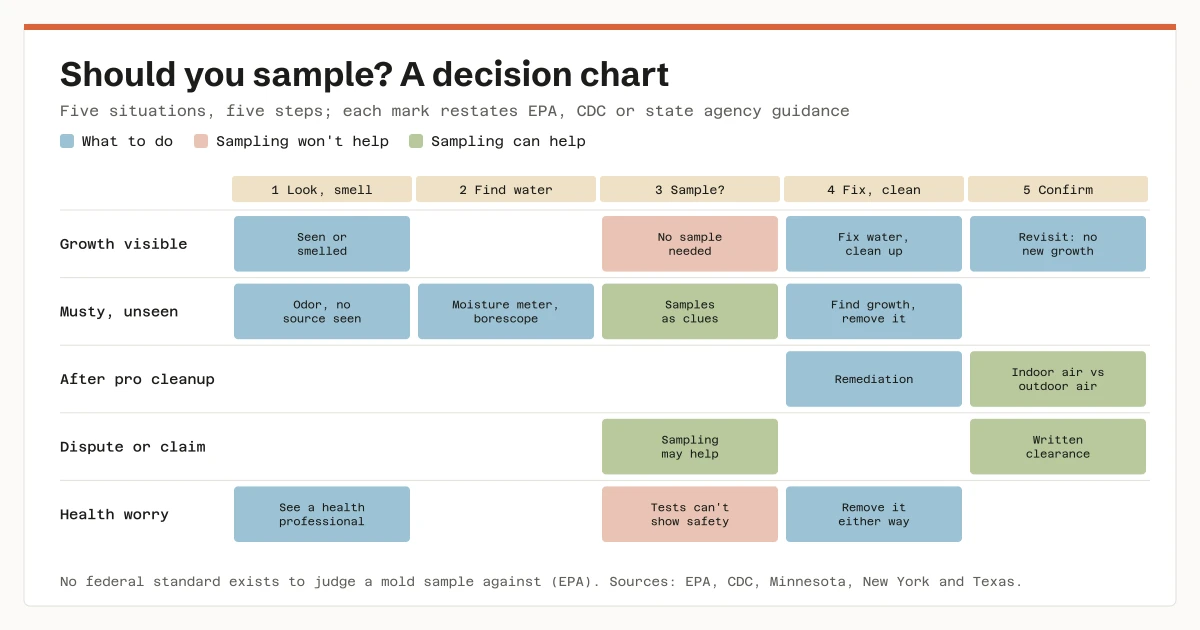
Usually not. If you can see or smell mold, a test won’t change what to do: find the water, fix it, and clean up. EPA says sampling is usually unnecessary when growth is visible, and CDC says plainly that it does not recommend mold testing. No federal standard exists to judge a result against. Testing earns its place in a few cases: a hidden source you can’t find, checking a professional cleanup, and disputes or claims.
Why EPA and CDC rarely recommend mold testing
EPA’s mold course is direct: “routine sampling for mold is not recommended.” Sample only if the results “would or could make a change in your plans” (EPA Mold Course, chapter 3).
CDC’s advice fits in one line: “CDC does not recommend mold testing.” People react to mold differently, and “there are no set standards for what is and what is not an acceptable quantity of different kinds of mold in a home.”
That missing yardstick is the heart of it:
- EPA says limits for airborne mold and spores “have not been set”, so a sample can’t show whether a house meets a federal standard.
- New York’s health department: “There is no state or federal standard for mold in homes.”
- California’s health department says no federal or state policy sets safe exposure limits.
Spores also turn up in every home. Minnesota’s health department expects molds to be found whenever testing is done properly. EPA expects a background level to remain even after a successful cleanup.
Is a mold test worth the cost?
Rarely, by the agencies’ own reckoning. New York’s health department says testing “can be more expensive than simply cleaning and repairing the water problems that allow mold to grow.” Minnesota reaches the same place: the money is usually better spent on fixing the moisture and cleaning up.
Visible mold or a musty smell?
When growth is in plain view, the type of mold doesn’t change the job. CDC says “You do not need to know the type of mold.” Stop the water, then clean or remove what is growing. The room-by-room prevention checklist covers the usual sources. Above about 10 square feet, EPA says cleanup is no longer a homeowner job.
A musty smell with nothing in sight is a different case. EPA’s course lists where mold hides: the back of drywall and wallpaper, the top side of ceiling tiles, the underside of carpet pads. Its first tools aren’t sampling pumps: “the most important equipment is your own eyes and nose,” then a flashlight and a moisture meter. An investigator may add a borescope, slipped through a small hole.
Minnesota agrees that a test can only offer clues; the growth “still has to be found by looking for it.” Keep the walls closed while searching. EPA warns that stripping wallpaper over hidden growth can send a cloud of spores into the room.
A hygrometer that keeps reading high also points to a moisture source. The indoor humidity guide gives the EPA and CDC targets.
How mold samples work
EPA’s remediation guide names four kinds of sample:
- Air.
- Surface, often clear tape pressed onto a suspect spot.
- Bulk: “chunks of carpet, insulation, wall board, etc.”
- Water from condensate drain pans.
A surface sample answers one useful question. EPA’s course says most microbiology labs can tell under a microscope “whether it is actually mold or something that looks like mold.” Paint on the back of drywall, mineral crystals on concrete and carpet stains can all pass for growth.
Air samples are harder to read. EPA compares one to a snapshot of “the moment in time in which the sampling occurred.” Minnesota adds that airborne levels can change within hours. So a sound air sample comes with an outdoor control sample from the same visit.
EPA lists the common mistakes: no outdoor sample, too few samples, and contaminated ones. If sampling can’t be done properly, “it would be preferable not to sample.”
Are DIY mold test kits worth it?
They fall into the same trap. Some microorganisms are always in the air, so a settle plate will grow something. Warning about air-duct cleaning sales pitches, EPA says “some growth on a settling plate is normal.”
California’s health department tells homeowners offered tests that identify or count their mold that “you do not need these tests to know if you have a mold or moisture problem.”
Choosing a mold inspector
Licensing depends on the state:
- Federal: EPA has no certification program for mold inspectors and keeps no list of firms, “though some states might.”
- Minnesota: neither the state nor any federal agency licenses mold investigators or remediators.
- New York: hiring someone for an area over 10 square feet requires a licensed assessor, then a licensed remediation contractor (New York mold program).
- Texas: collecting air or spore samples is licensed assessment work, and samples go to a licensed lab. That includes a real estate inspector who collects samples.
Questions worth asking, drawn from EPA and the state agencies:
- Experience and references. EPA asks for experience finding mold and water problems, checked references, and membership in professional organizations.
- Who does the cleanup. Minnesota’s consultant guide asks whether the firm also sells remediation. New York and Texas bar the same assessor from remediating the same project.
- A plan before any sample. EPA wants “a confirmable theory” about the source first. Texas advises agreeing on how results will be read before work starts.
- The lab. EPA says analysis should follow methods recommended by AIHA, ACGIH or other professional bodies. AIHA’s accreditation arm runs EMLAP, which accredits labs to ISO/IEC 17025:2017 for air, surface and bulk samples and offers a search for accredited labs.
What to do with mold test results
Whatever the report says, the next step is the same: find and stop the water, then clean or remove the growth. EPA says growth returns while the water problem stays. For a leak that keeps coming back, call a licensed plumber or roofer.
A low result is not proof of a sound house. Minnesota calls it “a common, yet serious error” to decide no problem exists because tests found none.
After a professional cleanup, sampling has its clearest job. EPA says indoor air afterward should hold mold types and concentrations “similar to what is found in the local outdoor air.” It also expects the water problem fixed, no visible growth or moldy odor, and no new water damage on a return visit. Even then, EPA calls the final decision “a judgment call.” In New York, the licensed assessor writes a passed clearance report. In Texas, only a consultant who wrote the remediation protocol beforehand can declare clearance.
In a dispute, EPA lists litigation among the cases where sampling may be considered. Minnesota mentions tests used to justify remediation expenses. It also notes that in most homes, results create no legal duty to fix a problem, and that insurance coverage depends on the policy.
For a health worry, a sample is the wrong tool. CDC says “you cannot rely on sampling and culturing to know whether someone might become sick.” EPA’s advice for anyone with health concerns is to consult a health professional before starting cleanup.
Sources
Each source was read on November 6, 2026.
- CDC, Mold
- EPA, Mold Testing or Sampling
- EPA, Mold Course, chapter 3
- EPA, Mold Remediation in Schools and Commercial Buildings, chapter 3
- EPA, A Brief Guide to Mold, Moisture and Your Home
- EPA, Who can test my home or clean, fix and remediate my home for mold?
- EPA, Should You Have the Air Ducts in Your Home Cleaned?
- New York State Department of Health, Mold and Your Home: What You Need to Know
- New York State Department of Labor, Mold Program and mold licensing fact sheet
- California Department of Public Health, Statement on Building Dampness, Mold, and Health and Mold or Moisture in My Home: What Do I Do?
- Minnesota Department of Health, Testing for Mold, Mold and Moisture and Guidelines for Selecting an IAQ Consultant
- Texas Department of Licensing and Regulation, Mold Assessors and Remediators FAQs
- AIHA Laboratory Accreditation Programs, Environmental Microbiology (EMLAP)