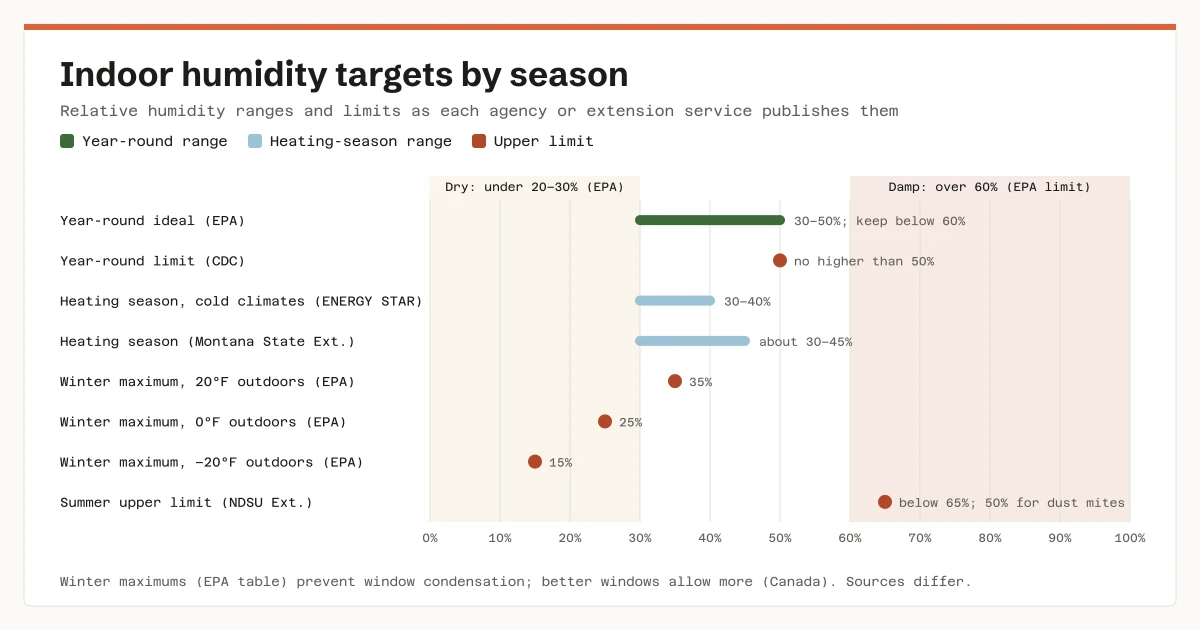
The ideal indoor humidity level, by most agencies’ advice, is 30 to 50 percent relative humidity. The upper limit is 60 percent in EPA’s guidance and 50 percent in CDC’s. In winter, the colder it is outside, the lower indoor humidity has to be to keep windows dry. An EPA table drops the maximum to 25 percent at 0°F outdoors. In summer the job is keeping humidity down. A hygrometer checked against a simple salt test tells you whether you are on target.
What does relative humidity measure?
Relative humidity (RH) is not the amount of water in the air. The National Weather Service defines it as a ratio, “expressed in percent, of the amount of atmospheric moisture present relative to the amount that would be present if the air were saturated.” It adds that RH “by itself does not directly indicate the actual amount of atmospheric moisture present.”
Warm air can hold more water vapor than cold air. So the same moisture reads as a higher RH when the air cools, and a lower one when it warms.
The more useful number is the dew point. That is the temperature the air would have to cool to before it reaches 100 percent RH and water condenses. The NWS La Crosse office shows how RH alone misleads:
- 30°F with a 30°F dew point is 100 percent RH.
- 80°F with a 60°F dew point is 50 percent RH.
Yet the 80-degree day feels far more humid.
This is why indoor humidity advice changes with the seasons. Indoor air at a comfortable RH still condenses wherever it touches a surface colder than its dew point. In winter that surface is the window glass. In summer it is a cold-water pipe, a basement wall or an air-conditioned room’s supply grille.
EPA puts it simply: as the temperature goes down, “the air is able to hold less moisture. This is why, in cold weather, moisture condenses on cold surfaces.”
RH also swings through the day without any change in moisture. The NWS notes it is usually highest in the early morning, when the air is coolest, and lowest in the afternoon. A single reading is a snapshot, not a verdict.
What is the ideal indoor humidity level?
Aim for 30 to 50 percent. The agencies agree on that middle and differ on the top:
- EPA: “If possible, keep indoor humidity below 60 percent (ideally between 30 and 50 percent) relative humidity,” says its guide to mold and moisture.
- CDC: stricter. Keep humidity “as low as you can — no higher than 50% — all day long.” CDC adds that “An air conditioner or dehumidifier will help you keep the level low.”
- HUD: its Healthy Home booklet uses 50 percent as the point to stop running a humidifier.
The comfort standard engineers use sets no RH number at all. ASHRAE Standard 55 caps moisture by humidity ratio. Its 2020 addendum says that cap corresponds to a dew point of 62.2°F, and notes “No lower humidity limit” for thermal comfort.
An earlier addendum explains that other factors may still limit very dry air: “skin drying, irritation of mucus membranes, dryness of the eyes, and static electricity generation.”
What happens when indoor humidity is too high?
Extra moisture feeds two problems:
- Dust mites. The National Institute of Environmental Health Sciences advises using “a dehumidifier or air conditioner to maintain humidity levels at, or below, 50 percent” against dust mites. EPA’s guidance for health professionals goes lower for people allergic to mites: “lower than 45 percent.” It treats readings outside 30 to 50 percent as a screening flag.
- Mold. ENERGY STAR’s dehumidifier page says anything above the 30 to 50 percent range “may promote mold growth.” EPA’s 60 percent ceiling is the outer edge of the same advice. How to prevent mold in the house covers the room-by-room sources of moisture.
What happens when it is too low?
Very dry air causes its own trouble. The same EPA page for health professionals says that “an unusually low level — below 20 or 30 percent — may heighten the effects of mucosal irritants and may even prove irritating itself.”
NDSU Extension links low humidity to “dry and cracking skin, static electricity and damage to furniture and musical instruments.”
If someone in the house has asthma or allergies, their doctor’s advice comes first. CDC’s asthma page uses the same “around 30- 50%” range.
What humidity should a house be in winter?
In a heated house in a cold climate, 50 percent is usually too high. Most winter advice lands between 30 and 45 percent:
- ENERGY STAR: “In colder climates, during the heating season, humidity levels should be in the range of 30% to 40% RH to prevent window condensation.”
- NDSU Extension: 30 to 40 percent in winter.
- Montana State University Extension: “around 30 to 45 percent” during the heating season.
- Virginia Cooperative Extension: drop below 35 percent once outdoor temperatures reach 20°F or lower.
The target keeps falling as the weather gets colder, because the glass gets colder. EPA reproduces a table of maximum indoor RH by outdoor temperature. It attributes the table to ASHRAE, with a source line crediting an extension specialist and the Association of Home Appliance Manufacturers.
| Outdoor temperature | Maximum indoor RH (EPA table) |
|---|---|
| 20°F | 35% |
| 10°F | 30% |
| 0°F | 25% |
| −10°F | 20% |
| −20°F | 15% |
Do better windows allow more humidity?
Yes. Environment and Climate Change Canada publishes maximum RH values by window type, at 21°C (70°F) indoors. At −20°C (−4°F) outdoors, the limits are:
- 34 percent for plain double glazing.
- 50 percent for double-glazed low-E.
- 67 percent for triple-glazed low-E.
The EPA and Canadian tables assume different windows. That is why their numbers differ so much at the cold end.
A practical rule follows from both: the windows tell you. NRCan says that if “excessive condensation appears on the interior surface of double-glazed windows (except those in the kitchen and bathroom), you have too much moisture in the air.”
Why does window condensation lead to mold?
Condensation that runs down the glass soaks the sash and the wall below, and repeated wetting is where mold starts. Oregon State University Extension notes that mold “can get a start whenever the relative humidity of air near a surface is above 70 percent RH.” So a cold corner or window frame can grow mold while the room reads a moderate 40 percent. EPA’s guide to mold and moisture lists the fixes:
- Reduce the humidity.
- Increase ventilation or air movement.
- Insulate cold surfaces.
- Raise the air temperature.
In practice, run the bathroom fan when showering and the range hood when cooking. Don’t let a humidifier run unchecked. Condensation on the inside of windows and the range hood CFM guide go further.
A dehumidifier is not the winter fix. NDSU Extension notes that dehumidifiers “generally lower the humidity level to only about 50 percent, so they are not adequate for limiting condensation during the winter.” In winter, ventilation and source control do that work.
How do you keep humidity down in summer?
Summer reverses the problem: outdoor air brings moisture in, and the goal is to remove it. NDSU Extension says that during the summer “indoor humidity levels should be kept below 65 percent to minimize the potential for mold growth and below 50 percent to minimize dust mites.” That 65 percent figure is higher than EPA’s 60 and CDC’s 50. Treat it as an outer limit, not a target.
Air conditioning removes some moisture, but not always enough. The U.S. Department of Energy notes that modern AC systems are “very effective at reducing the temperature, but not as effective at removing moisture from the air.” That can leave rooms “cold and clammy.” EPA adds that air conditioners which cool the air too quickly may not run long enough to remove excess moisture.
Basements and crawl spaces are where summer dampness collects. EPA’s mold course calls crawl spaces with high RH “common sites of hidden mold growth, particularly if the crawl space has a bare earth floor.”
For a damp basement, ENERGY STAR’s dehumidifier page suggests:
- Improve drainage around the foundation.
- Choose a dehumidifier with a built-in humidistat, so it cycles to hold the level you set.
- In a cool basement, look for a model rated for low temperatures, since frost can form on the coils below 65°F.
What size dehumidifier you need and basement moisture: condensation or a leak cover sizing and diagnosis.
What if the room smells musty?
Humidity readings don’t replace your nose. A persistent musty smell usually means mold is already growing somewhere, even if the room reads within range. EPA says water-damaged areas and items need drying “within 24-48 hours to prevent mold growth.” Musty smell in the house and should you test your house for mold cover the next steps.
For mold covering a large area or after flooding, EPA’s guidance and a licensed remediation professional are the right starting points.
How do you measure indoor humidity?
A hygrometer, often combined with a thermometer, is the only way to know the number. Accuracy varies widely:
- Mechanical hygrometers “are frequently in error by more than 20 percent,” NDSU Extension warns.
- Electronic meters “tend to be more accurate, but they should also be calibrated.”
- Low-cost devices are usually within plus or minus 5 percent RH, which the University of Kentucky’s extension guide calls “the norm for low-cost devices.” Some data loggers are rated at plus or minus 2 percent.
At that tolerance, a reading of 45 percent could really be anywhere from 40 to 50.
How do you check a hygrometer?
Use the salt test. Table salt and a little water in a sealed container hold the air at close to 75 percent RH. Extension services give slightly different methods:
- NDSU: seal the hygrometer in a plastic bag with a cup holding 1/2 cup of water and 1/4 cup of table salt. Leave it about 12 hours at room temperature, and expect a reading of about 75 percent.
- University of Kentucky: use about half an inch of salt with enough water to make a mushy mixture. Seal it with the instrument for one to two hours, out of direct sun, and keep the instrument from touching the mixture. Its table puts salt at 75.5 percent at 68°F. So a steady reading of 77 percent means subtracting 1.5 from future readings.
- University of Hawaiʻi: its test units were equilibrated for 24 hours at 25°C, with salt at 75.29 percent RH at that temperature.
Whichever method you follow, note the offset and apply it to later readings. The Kentucky guide says a one-point check like this gives “reasonably reliable readings for 10 to 15% relative humidity above or below the calibration value.” That covers most of the indoor range.
Where should a hygrometer go?
Put it in the shade, where room air moves over it. The Kentucky guide notes that readings in direct sun “will not be the same as the more accurate readings taken in a shaded location with ambient air moving over the instrument.” Most units need 15 to 30 minutes to settle after being moved.
- Keep it away from the kettle, the shower and the humidifier’s outlet.
- ENERGY STAR suggests hanging one near a dehumidifier to check its built-in humidistat.
- CDC’s asthma page advises checking “more than once a day”.
How do you read it by season?
In winter, compare the reading with the outdoor temperature and the table above. Watch the bottom corners of the windows. Canada’s National Research Council says that is where condensation on double windows “usually occurs first”.
In summer, aim to stay at or below 50 percent in living spaces. Watch the basement separately, since it usually runs damper.
How to improve indoor air quality and MERV ratings explained cover the rest of the air in the house.
Sources
Each source is listed with the date it was read.
- National Weather Service, Glossary: relative humidity, read November 4, 2026; Louisville office: humidity, read November 4, 2026; and La Crosse office: why dew point vs. humidity, read November 4, 2026
- EPA, A Brief Guide to Mold, Moisture and Your Home, read November 4, 2026
- EPA, What are the main ways to control moisture in your home?, read November 5, 2026
- EPA, Indoor Air Pollution: An Introduction for Health Professionals, read November 4, 2026
- EPA, Mold Course, chapter 2, read November 4, 2026
- CDC, Mold, read November 5, 2026; and Controlling Asthma, read November 5, 2026
- HUD, Help Yourself to a Healthy Home, read November 5, 2026
- ASHRAE, Standard 55-2017, addendum d, read November 5, 2026
- National Institute of Environmental Health Sciences, Dust Mites, read November 4, 2026
- ENERGY STAR, Dehumidifiers, read November 4, 2026
- U.S. Department of Energy, Advanced HVAC humidity control for hot-humid climates, read November 5, 2026
- North Dakota State University Extension, measuring humidity to avoid dry skin, respiratory irritations and excess moisture, read November 4, 2026; and eliminating condensation on windows, read November 4, 2026
- Montana State University Extension, Controlling Condensation, read November 5, 2026
- Virginia Cooperative Extension, publication 324-866, read November 5, 2026
- Oregon State University Extension, EC 1437, read November 5, 2026
- University of Kentucky, AEN-87, read November 4, 2026
- University of Hawaiʻi CTAHR, FST-70, read November 4, 2026
- Environment and Climate Change Canada, Keeping the Heat In, table 9-1, read November 6, 2026
- National Research Council Canada, Canadian Building Digest 4, read November 5, 2026