A useful flooring types comparison starts with the room, not the look. Water and the level of the floor rule out more choices than taste does.
Solid hardwood stays out of basements and full bathrooms. Engineered wood can go below grade but still not in a full bathroom. Laminate needs the maker’s say-so for wet rooms. “Waterproof” vinyl covers spills on top, not floods. Porcelain tile handles water best, and carpet belongs in dry rooms.
How should you compare flooring types?
Compare them on three things, in this order:
- Where the floor sits. Below grade means below the soil line, as in most basements. Some floors are ruled out there.
- How much water reaches it. A kitchen sees spills. A full bathroom sees splashes and puddles. A laundry room risks a burst hose.
- How it feels and wears. Hardness, warmth, noise and how it ages come last, once the first two have narrowed the list.
The limits come from the makers. The installation guide says which rooms a floor may go in. The warranty says which water damage is covered. Check both for the exact product, because one brand’s terms don’t carry over to another.
Hardwood and engineered wood
What is the difference between solid and engineered hardwood?
Solid hardwood is milled from one piece of wood, typically 3/4″ thick. Engineered hardwood is several thin layers of real wood glued together.
That build decides where each can go. Solid wood belongs on or above grade, and never in a full bathroom. Engineered wood can also go below grade, in a basement, but full bathrooms are still off limits. Shaw’s engineered line allows below-grade installs too.
Which rooms suit wood floors?
Most of them. The exceptions are rooms that get damp: bathrooms, laundry rooms and mudrooms. In a basement, engineered wood is the better of the two.
Kitchens aren’t on that damp list. Still, wipe up spills quickly and read the warranty for the floor you pick.
How does wood hold up over time?
Wood swells and shrinks with the seasons. Engineered wood needs indoor humidity between 35% and 55% before, during and after it goes down. Expect small gaps between boards in dry months. Outside that range, fine surface cracks (called checking) can appear, and you may need a humidifier to stay in range.
Wood’s big advantage is that it can be renewed. Solid hardwood can usually be sanded and refinished more than once, and thicker boards allow more rounds.
Refinish vs recoat explains when a fresh coat is enough. How to clean hardwood floors covers daily care, and how to fix squeaky floors deals with the noise older boards make.
Is there waterproof wood flooring?
Yes, but “waterproof” means spills, not floods. Shaw’s waterproof wood won’t swell, cup or crack from water spilled on top. It isn’t built to survive standing water or flooding.
Makers also disagree about bathrooms. Shaw allows its waterproof wood in wet areas such as bathrooms, with silicone caulk around the edge of the room. Bruce’s waterproof hardwood still says no to full bathrooms. The word on the box doesn’t settle it; the installation guide does.
Laminate
What is laminate, and how does it handle water?
Laminate is a printed wear layer on a core of wood fibre board. Water is its weak point, because it gets in at the joints.
Even a careful install can’t guarantee sealed joints, according to the laminate makers’ trade body. So don’t wet-mop laminate or scrub it with lots of water.
Laminate is fine in a home kitchen. Bathrooms and laundry rooms are different: laminate goes there only if its maker allows it, and only under that maker’s installation rules.
What does waterproof laminate actually cover?
Spills on top, as long as the water doesn’t run over an edge, such as the edge of the room or a cut board. Under Shaw’s waterproof laminate warranty, the floor won’t swell, cup or crack from normal cleaning or everyday spills.
It does not cover flooding, or standing water from leaky pipes, faucets or appliances. And the floor has to be installed exactly as Shaw’s guidelines say.
In practice, that means silicone caulk around bathtubs, toilets, sinks and the edges of the room. And never leave liquid standing on the floor.
What should you check on the label?
Laminate cores and engineered wood are both composite wood, so they fall under the federal formaldehyde rule. Products sold in the US must be labeled TSCA Title VI compliant. Look for that label when you buy.
EPA’s laminate flooring advice for any home is simple: cut down sources of formaldehyde, ventilate, and keep temperature and humidity low.
Luxury vinyl plank and tile
Is luxury vinyl plank really waterproof?
The plank often is. The room around it isn’t, and warranties say so plainly.
Rigid-core vinyl from AHF won’t swell, buckle or fall apart when wet. But it won’t stop standing water or flooding from reaching the subfloor, and that damage isn’t covered.
Shaw’s vinyl warranty uses the same edge rule as its laminate: spills are covered only if the water doesn’t run over an edge. Flooding, moisture coming up through the subfloor, and leaks from plumbing, faucets or appliances are all excluded.
Where does water go when it gets under vinyl?
It sits on the subfloor, out of sight. Shaw’s warranty warns that hidden subfloor moisture can lead to mold. The CDC’s advice is to fix leaks in the roof, walls or plumbing so mold has no moisture to grow on. After a leak, dry the subfloor, not just the surface.
Two more conditions are easy to miss. With Shaw, testing the subfloor for moisture is the installer’s job, and the floor must be installed indoors. AHF’s warranty also excludes floors installed outdoors.
For the install itself, see how to install vinyl plank flooring and whether vinyl plank needs underlayment.
What if there is old vinyl underneath?
Old floors can hide asbestos. EPA lists old vinyl floor tiles, the backing on sheet vinyl, and their adhesives as places it may be found. It’s generally a risk only when the material is disturbed or damaged.
So don’t sand, scrape, drill or saw old resilient flooring or “cutback” adhesive. Bruce’s instructions say to assume it contains asbestos unless you know it doesn’t, and local rules may require a test. Floating the new floor over the old one leaves the old one undisturbed, which is what EPA’s guidance points to. Leave any removal to a licensed abatement professional.
Why is porcelain tile the safest choice for water?
It barely absorbs any. Porcelain takes in less than 0.5% water, which makes it close to waterproof. It suits bathrooms, kitchens and patios. Ceramic tile absorbs more and is better kept to dry indoor rooms.
How slippery is tile when wet?
Slip resistance is rated as DCOF. For level indoor floors that get wet, the industry standard (ANSI A137.1) calls for a wet DCOF of 0.42 or higher.
No tile is slip-proof, though. Polished tile isn’t recommended where floors get wet or greasy. For a bathroom or kitchen, check the wet DCOF on the tile’s data sheet.
Tile’s weak spot is the grout, which needs regular cleaning. How to clean tile floor grout covers it.
Carpet
Where does carpet work, and where does it not?
In dry rooms. The CDC advises against carpet in damp places such as bathrooms and basements. It also says to remove carpet that has been soaked and can’t be dried right away.
Carpet on concrete needs extra care too. It soaks up moisture and can become a place for biological pollutants to grow. EPA suggests area rugs instead, because they can be taken up and washed often.
How do rugs add comfort to hard floors?
They give you the best of both. Put a hard floor where water is likely, then add washable rugs for softness and warmth. What size rug you need helps with sizing, and whether you need a rug pad explains what a pad adds.
Matching floor to room
How do the six floors compare side by side?
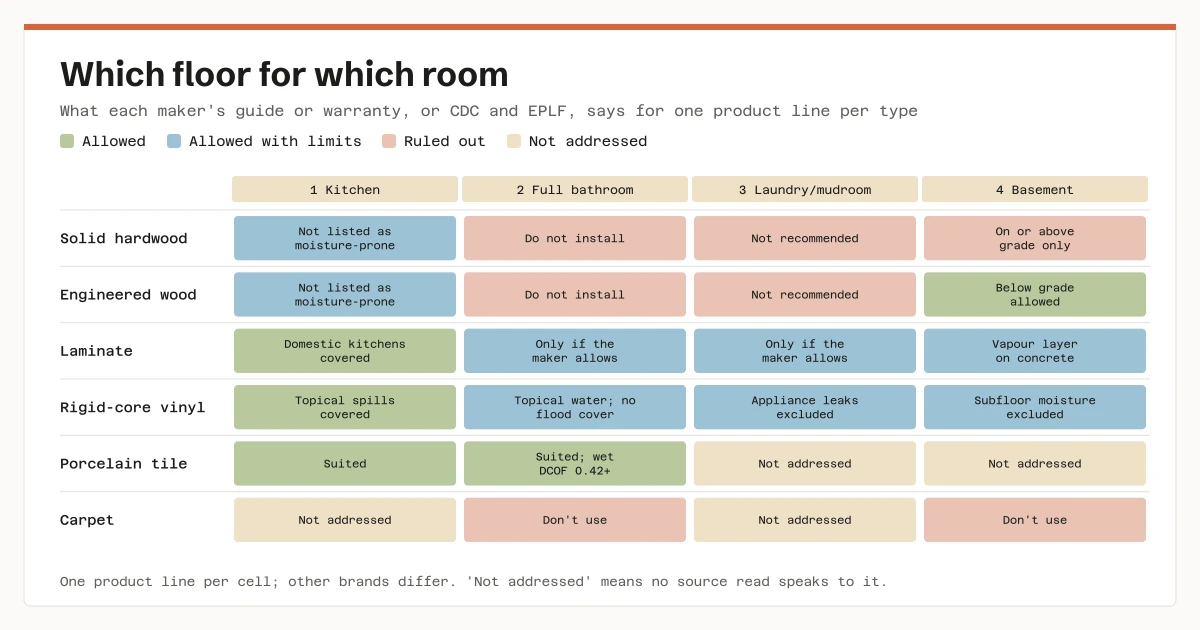
Each row sums up the sections above, for the product lines named there. Other brands may differ.
| Floor | Basement | Full bathroom | Water it handles | Check before you buy |
|---|---|---|---|---|
| Solid hardwood | No: on or above grade only | No | Spills, wiped up fast | Can be sanded and refinished more than once |
| Engineered wood | Yes | No | Spills; needs 35–55% humidity | Installation guide for grade and room |
| Laminate | Needs a vapour layer on concrete | Only if the maker allows it | Spills that stay on the surface; no wet-mopping | TSCA Title VI label |
| Rigid-core vinyl | Subfloor moisture isn’t covered | Spills covered; flooding isn’t | Spills on top, not floods or appliance leaks | Warranty’s edge, flood and leak exclusions |
| Porcelain tile | Not addressed by the sources | Yes | Absorbs less than 0.5% | Wet DCOF of 0.42 or more |
| Carpet | No | No | Remove it if soaked and it can’t dry fast | Keep it to dry rooms; use washable rugs elsewhere |
Which flooring is best for each room?
Use the chart above as a first filter, then check the guide for the exact product.
- Living rooms and bedrooms: every type here works. The choice comes down to feel, care and how the floor ages.
- Kitchen: porcelain tile, vinyl plank, laminate and engineered or solid wood are all used. Carpet is the odd one out.
- Full bathroom: porcelain tile with a wet DCOF of 0.42 or more. Vinyl or laminate only where the maker allows wet areas, with the edges sealed as it directs.
- Laundry room or mudroom: Bruce rules out its hardwood here. Laminate needs the maker’s approval, and vinyl warranties exclude appliance leaks.
- Basement: no solid hardwood and no carpet. Engineered wood is allowed below grade. Vinyl warranties exclude subfloor moisture, and Shaw makes moisture testing the installer’s job.
Where two floors meet, the height difference needs the right trim. Floor transition strip types explains the options.
What to check before you buy
- The installation guide allows the room and its level: above, on or below grade.
- The warranty’s water wording, including its edge, flooding and appliance-leak exclusions.
- For laminate and engineered wood, the TSCA Title VI label.
- For tile, the wet DCOF and the water absorption on the data sheet.
- For an older home, what is under the current floor before anything is torn up.
Sources
- Bruce, Hardwood Flooring FAQs, read on November 7, 2026
- Bruce, 5/16″ solid hardwood installation instructions, read on November 7, 2026
- Bruce, waterproof locking hardwood installation instructions, read on November 7, 2026
- Bruce Pro Center, Hardwood Structure and Construction, read on November 7, 2026
- AHF Products, TimberTones installation instructions, read on November 7, 2026
- AHF Products, Rigid Core, LVT and VBT Flooring Limited Warranty, read on November 7, 2026
- Shaw, Engineered Hardwood Flooring Installation Guidelines, read on November 7, 2026
- Shaw, Waterproof Wood Flooring floating installation instructions, read on November 7, 2026
- Shaw, Residential Waterproof Laminate Limited Warranty, read on November 7, 2026
- Shaw, Repel Laminate Installation, read on November 7, 2026
- Shaw, Pet Perfect Residential Resilient Limited Warranty, read on November 7, 2026
- European Producers of Laminate Flooring, Technical Bulletin: Installation of Laminate Floor Coverings, read on November 7, 2026
- Daltile, Ceramic vs. Porcelain Tile, read on November 7, 2026
- Daltile, DCOF Slip Resistance Testing, read on November 7, 2026
- EPA, Formaldehyde Emission Standards for Composite Wood Products, read on November 7, 2026
- EPA, Questions and Answers Regarding Laminate Flooring, read on November 7, 2026
- EPA, Learn About Asbestos, read on November 7, 2026
- EPA, What are the main ways to control moisture in your home?, read on November 7, 2026
- CDC, About Mold and Your Health, read on November 6, 2026