Measure the joint. Sanded vs unsanded grout comes down to its width. Unsanded grout is made for joints up to 1/8 inch, and sanded grout for joints from 1/8 inch up to 1/2 or 5/8 inch, depending on the maker. Epoxy and premixed grouts cover roughly 1/16 to 1/2 inch, resist stains and skip sealing, but are harder to work.
What does grout do?
Grout fills the joints between tiles. It does not glue the tile down. The Tile Council of North America (TCNA) puts it plainly in its ceramic tile FAQ: “Grout is joint filler. It is not designed to hold the tile in place.”
Nor does it keep water out of the wall: “Remember that grout joints are not waterproof. If you are doing a wet-area (such as a shower), rely on the method and substrate to protect adjoining areas from water.” That job belongs to the membrane behind the tile. The bathroom remodel planning guide covers it in order.
Grout also stays out of the corners, which take caulk instead. Custom Building Products’ sheets say its grouts are “Not for use in movement joints or changes of plane”. Bostik says to caulk floor-to-wall corners after the grout cures. The bathtub re-caulking guide covers that bead.
Sanded vs unsanded grout: which joint width?
Each grout is made for a range of gap sizes. These are the ranges as each maker prints them on its data sheet:
| Grout | Type | Joint width |
|---|---|---|
| Custom Polyblend Plus Non-Sanded | Cement, unsanded | Up to 1/8 in. |
| MAPEI Keracolor U | Cement, unsanded | 1/16 to 1/8 in. |
| Custom Polyblend Plus Sanded | Cement, sanded | 1/8 to 1/2 in. |
| MAPEI Keracolor S | Cement, sanded | 1/8 to 5/8 in. |
| LATICRETE PERMACOLOR Select | Cement, high performance | 1/16 to 1/2 in. |
| Custom CEG-Lite | Epoxy | 1/16 to 1/2 in. |
| LATICRETE SPECTRALOCK PRO Premium | Epoxy | 1/16 to 1/2 in. |
| Custom Fusion Pro | Premixed, single component | 1/16 to 1/2 in. |
| Bostik TruColor RapidCure | Premixed, urethane | Floors 1/16 to 1/2 in.; walls 1/16 to 1/4 in. |
Below 1/8 inch, use unsanded. MAPEI’s sanded sheet says, “Do not use to grout joints less than 1/8″ (3 mm) wide”. Its unsanded sheet says the reverse for joints over 1/8 inch. Custom’s ranges split at the same point.
At exactly 1/8 inch, let the tile decide. Both makers list a sanded and an unsanded grout there. Polished stone, glass and high-gloss glaze point to unsanded:
- Custom describes its non-sanded grout as made for “highly glazed or polished tile, marble and natural stone that would be scratched by sanded grouts”.
- It warns that some ceramic, glass, metal, marble and stone tiles “can be scratched or damaged by the silica aggregate filler” in its sanded grout.
- Test any grout on a spare tile first, as both makers advise.
Above 1/8 inch, sanded cement grout is the default, up to its maker’s limit: 1/2 inch for Polyblend Plus Sanded, 5/8 inch for Keracolor S.
Some grouts span both ranges. PERMACOLOR Select, both epoxies and both premixed grouts above cover joints from 1/16 inch. LATICRETE notes that SPECTRALOCK is itself “a sanded grout” and that in joints under 1/8 inch it gives “a coarser surface”. Bostik caps TruColor at 1/4 inch on walls.
Is epoxy or premixed grout worth it?
Epoxy is a two-part resin grout sold for stain and chemical resistance. CEG-Lite and SPECTRALOCK PRO Premium are both rated to ANSI A118.3, and neither needs sealing. The trade is working time:
- Custom says all grouting and cleaning with CEG-Lite “should be completed within 80 minutes”. Epoxies spread most easily between 70°F and 85°F.
- LATICRETE’s working time drops from 120 minutes at 40°F to 30 minutes at 95°F.
- LATICRETE warns that epoxy resins “may affect the color of white or porous stones” such as Carrara marble.
- Custom warns that enzyme-based cleaners break down cured epoxy.
Premixed grouts come ready to spread from the pail. Bostik’s current TruColor sheet lists “polyurethane polymer” in its contents and claims it “never needs to be sealed”. Custom’s Fusion Pro lists “acrylic latex” and calls itself stain proof; Custom does not call it urethane.
They cure in different ways. Custom says Fusion Pro “cures by evaporation”. Bostik says humidity matters more than temperature to TruColor’s cure speed: the drier the air, the faster the cure.
One limit matters for bathrooms. Bostik’s sheet says not to use TruColor for “wet environment regrouting installations, including showers”. If the job is regrouting an old shower rather than grouting new tile, that rules it out.
How long before the shower can be used?
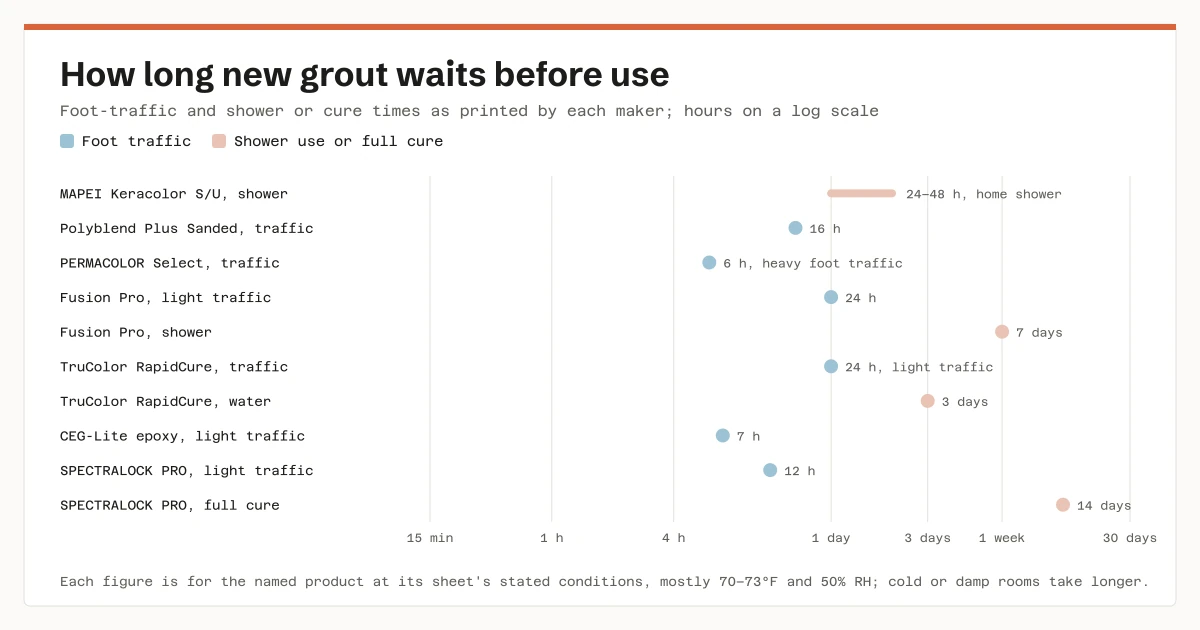
Waits differ widely. Before a shower, MAPEI asks for 24 to 48 hours with Keracolor S or U, Bostik 3 days for TruColor, and Custom 7 days at 70°F and 50 percent humidity for Fusion Pro. The chart above gives each maker’s traffic and cure times.
Wear nitrile gloves, safety glasses and an N95 respirator with cement grout. It contains Portland cement and silica sand. Custom’s sanded grout sheet calls for that gear, warns of severe skin burns and says, “You cannot rely on pain to alert you to cement burns”.
Wear the respirator while pouring and mixing powder, and control dust when grinding out old grout. OSHA explains that respirable crystalline silica is created when cutting, sawing or grinding stone, concrete and mortar, and links it to silicosis and lung cancer.
The epoxy and premixed sheets warn that their grouts may irritate skin; LATICRETE asks for gloves, long sleeves and safety glasses.
Does grout need sealing?
None of the sheets read for this guide says its grout must be sealed:
- Custom Polyblend Plus, sanded and non-sanded: a penetrating sealer is optional, “If the use of a sealer is desired for extra protection”.
- MAPEI Keracolor S and U: “Sealing is not required”, though a penetrating sealer may be applied.
- LATICRETE PERMACOLOR Select: “Does not require sealing”; if it is sealed, LATICRETE generally recommends waiting at least 72 hours at 70°F.
- Custom Fusion Pro: “Sealing is not necessary”, and solvent-based sealers or enhancers must not be used on it.
- Epoxies and TruColor: no sealing, by each maker’s sheet.
Sealing the tile before grouting is a separate step. Custom recommends a sealer or grout release on tile or stone “subject to staining or when using a grout that contrasts with the color of the tile”. MAPEI says absorbent or rough tiles may need it to avoid permanent staining.
What grout color hides dirt best?
No sheet read here claims a given shade hides dirt, so pick for how evenly the color holds. The sheets name the risks:
- Batch variation. Custom says to dry-mix bags from different batches together, because they “can vary slightly in color”.
- Cleanup. Custom advises using “as little water as possible for cleanup” to limit color variation. LATICRETE says not to use acid on colored grout joints.
- Lighting and samples. Custom notes that lighting changes how grout and tile look, and recommends a mock-up. Its epoxy sheet warns that colors “may be slightly different than shown on color samples”.
The premixed grouts are sold on color holding. Bostik says TruColor’s colors “will not yellow, darken, or fade”, and Custom calls Fusion Pro “color perfect”. Grout a spare board with the chosen color and let it cure. Then judge it in the bathroom’s own light before committing.
Sources
Each source was read on November 5, 2026.
- Tile Council of North America, Ceramic Tile FAQ
- Custom Building Products, Polyblend Plus Non-Sanded Grout data sheet (TDS-369), Polyblend Plus Sanded Grout data sheet (TDS-360), CEG-Lite data sheet (TDS-101) and Fusion Pro data sheet (TDS-242)
- MAPEI, Keracolor U data sheet and Keracolor S data sheet
- LATICRETE, PERMACOLOR Select data sheet (DS-281) and SPECTRALOCK PRO Premium Grout data sheet (DS-681)
- Bostik, TruColor RapidCure Premium Pre-Mixed Urethane Grout data sheet
- OSHA, Silica, Crystalline